

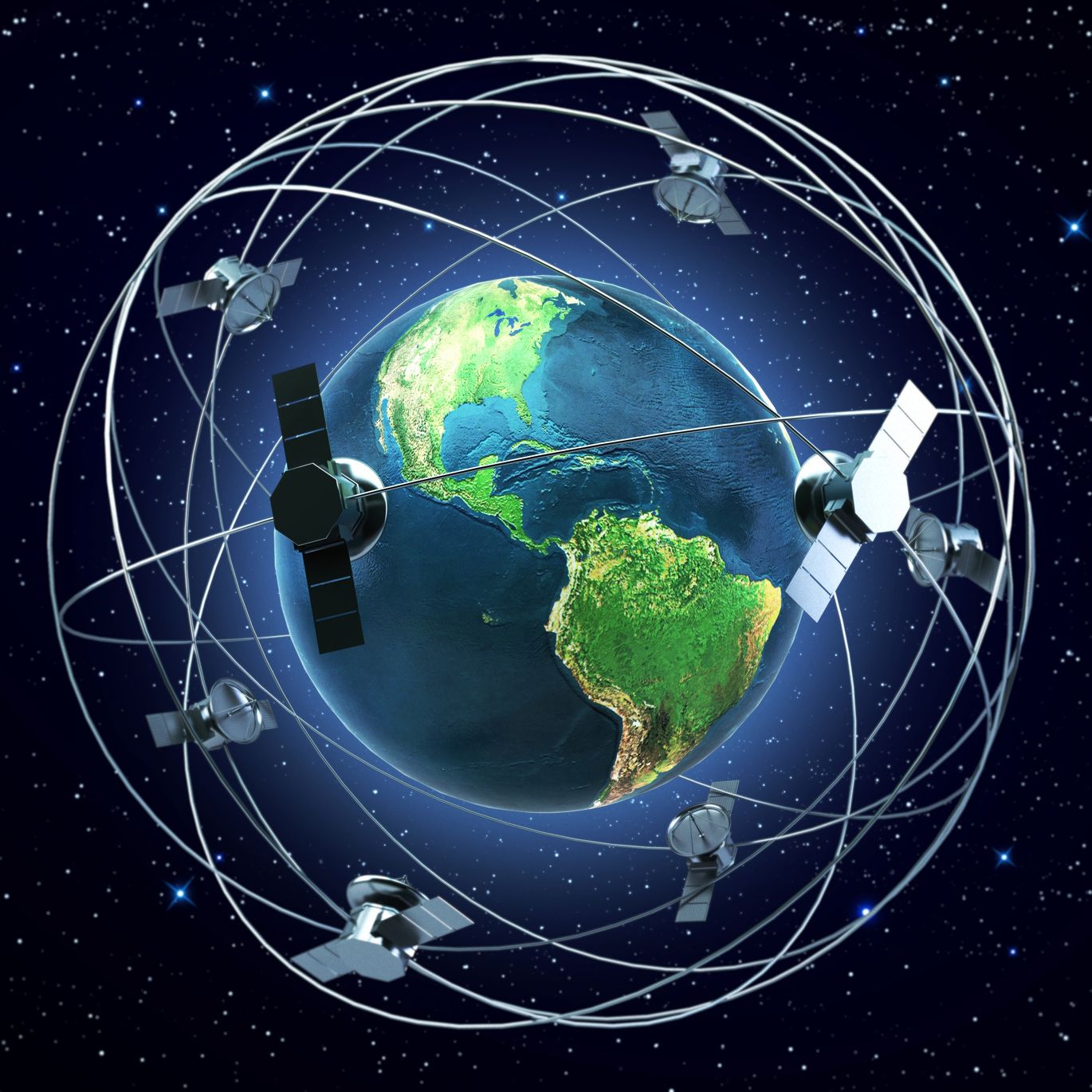
Artist’s rendition of satellites orbiting the Earth – rottenman/123RF Stock Photo
Last week representatives from the twenty-three member states of the European Space Agency, alongside other associate and cooperating nations, met for the Council meeting at Ministerial Level which determines what ESA programs will be supported over the coming years, alongside the funding levels being committed.
Council Meeting at Ministerial Level (CM25) took place in Bremen, Germany and the outcome was an agreement of funding worth €22.1 billion, which is the largest ever agreed three-year contribution in ESA’s history and this represents a 32% increase, or 17% increase if corrected for inflation, on ESA’s 2022 Ministerial Council (CM22). It is an exciting development in ESA’s 50th year.
In terms of the countries funding ESA: Germany has the largest contribution worth 23.11% of the total, followed by France with 16.42%, Italy with 15.79%, and in fourth is Spain with 8.64%.
The UK is the fifth biggest contributor with 7.78%, although this is a reduction on the contribution from CM22 where the UK was the fourth biggest contributor at 11.24%, which equates to €172 million less of funding in this round and is a 9.52% reduction. It should also be noted that the UK’s contribution is even lower as earlier this year the Government unilaterally pulled their funding from the UK led TRUTHS satellite mission causing the mission to be terminated, with the funding begin reallocated. We were very saddened by this decision, which was result of a change in priorities by the UK Government, rather than a reflection of how the mission was developing.
In terms of the different areas of ESA, the breakdown of the overall funding is:
- Space Transportation – 20%
- Scientific Programme – 17%
- Earth Observation – 16%
- Human and Robotic Exploration – 13%
- Connectivity & Secure Communication – 9%
- Basic Activities – 8%
- Navigation – 4%
- Space Safety – 4%
- Technology – 4%
- Commercialisation – 1%
- Prodex Programme (PROgramme de Développement d’Expériences scientifique) – 1%
I know this only adds up to 97%, but this was all the breakdown supplied by ESA!
Earth Observation
It is fantastic to see Earth Observation (EO) having €3.455 billion of funding for the next cycle. It is hoped that this investment will enable Europe to take a global lead in EO, particularly with the United States pulling back from the field – although China may have a view on this, although they don’t share their data as widely within the community. As well as boosting the overall EO programme, some of the key aspects this funding will support in the coming years include:
- European Resilience from Space Initiative – EO, alongside navigation and telecommunications, form the three core elements of this critical initiative providing space assets input in security and resilience. In EO terms, this includes improving Europe’s access to high-resolution satellite images includes pooling and sharing resources to fill observational gaps. The clear mandate for use of space applications for non-aggressive defence purposes within this initiative signifies a historic change for ESA.
- Copernicus Sentinel-4 – Will provide hourly monitoring of air quality, trace gases, and aerosols over Europe at high spatial resolution, together with enhancing weather prediction accuracy.
- Biomass satellite – This satellite was launched earlier this year and will provide new data on global forests. The first images are expected to be shared shorly, providing a new and vital source of information for climate change research.
- FutureEO – This will enable ESA to develop and operate world-class Earth science missions, prepare future operational Copernicus and meteorological missions, and support the use of data for Earth Action.
- Copernicus Programme – Preparation of the second generation of Copernicus satellites – specifically the Sentinel-2 Next Generation and Sentinel-3 Next Generation Optical missions.
Conclusion
As a company that works on several ESA projects it is fantastic to see the overall financial budget of the agency increase – even though it is disappointing that the UK Government has decided to scale back our involvement. We look forward to seeing how the new programmes develop over the coming years!
