


Zoomed in Sentinel-2B image of Menindee, New South Wales, Australia. Image acquired on the 19th March 2023. Image courtesy of ESA/Copernicus, processing by Pixalytics Ltd.
Last Friday the residents of Menindee, an Australian town, awoke to the horrible sight of their river awash with millions of dead fish.
According the WaterNSW, the New South Wales state river authority, the Darling-Baaka River has suffered hypoxic blackwater, a natural event which causes extremely low oxygen levels – although the cause of this is not known. In addition, recent flooding has deposited organic matter in the river and there have been extremely high temperatures – over the weekend Menindee itself hit 41 degrees Centigrade (105.8 degrees Fahrenheit) – both of which decreased the amount of dissolved oxygen the water can hold to fall even further, resulting in a mass fish death event. This is not the first mass fish death in the area which has seen with similar events in 2018 and 2019, but this event is the largest.
The town, which has approximately 500 residents, relies on the river for water supplies for washing and showing, and the local authorities are monitoring the water quality of the area. The dead fish are mostly bony bream, and there are plenty of images online of these white fish floating on the river, although golden perch, silver perch, Murray cod and carp – most populous fish species on the river – have also died.
The image at the top of the blog was acquired by Sentinel-2B on the 19th March 2023 and shows the town of Menindee in the top right, with the river winding underneath and down the left side of the image. Following the river, at some of the twists, there are areas of bright white in the river, which could be the dead fish showing up on the satellite image. The image also shows that the fish are flowing down the river, and it is believed that up to 30 kilometres of this water body has already been impacted by this event. A netting approach is starting to remove the dead fish, whilst the charity, OzFish, is attempting to retrieve any surviving native fish.
It is likely a significant amount of the dead fish will also sink into the river causing an increase in nutrients and the potential for an algal bloom. The state water authority has increased monitoring in the Menindee Lakes area, tracking the impact of the flooding.
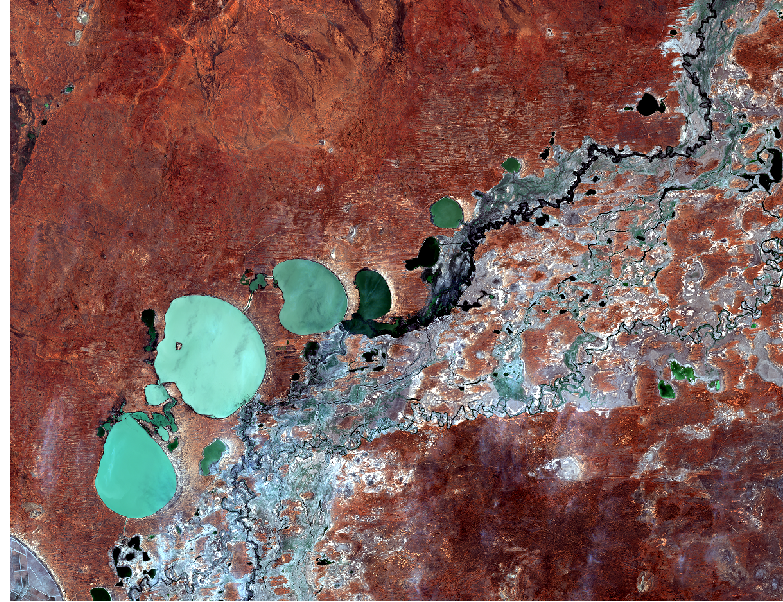
Sentinel-2B image of the area around Menindee, New South Wales, Australia. Image acquired on the 19th March 2023. Image courtesy of ESA/Copernicus, processing by Pixalytics Ltd.
Part of this lake system can be seen in the Sentinel-2 image on the right, which is the full image from the 19th March 2023. Starting at the bottom left, there is Lake Cawndilla, Menindee Lakes, and Lake Pamamaroo, all of which appear green on the image indicating the presence of algae and potentially poor water quality. The remaining lakes, Tandure Lake & Lake Wetherall, Lake Bijijie and finally the almost circular Balaka Lake appear less impacted as they progress up to the middle of the image.
Whilst this is the third such event in five years, it is unlikely to be the last event according to Intergovernmental Panel on Climate Change (IPCC). This week they released their Synthesis Report for the Sixth Assessment Report that indicated that all regions of the world have seen increases in extreme heat events. However, it is not only climate change that fingers have been pointing at, as how the water in the Murray Darling Basin, part of Australia’s largest river system, is being used has also been highlighted; agriculture, industries and communities have extracted water, which has resulted in less water flowing and has impacted the health of the river ecosystem.
This is a horrific event resulting, most likely, from climate change, and sadly, there are likely to be more of these if the world does not began to take actions outlined in the IPCC report.
