

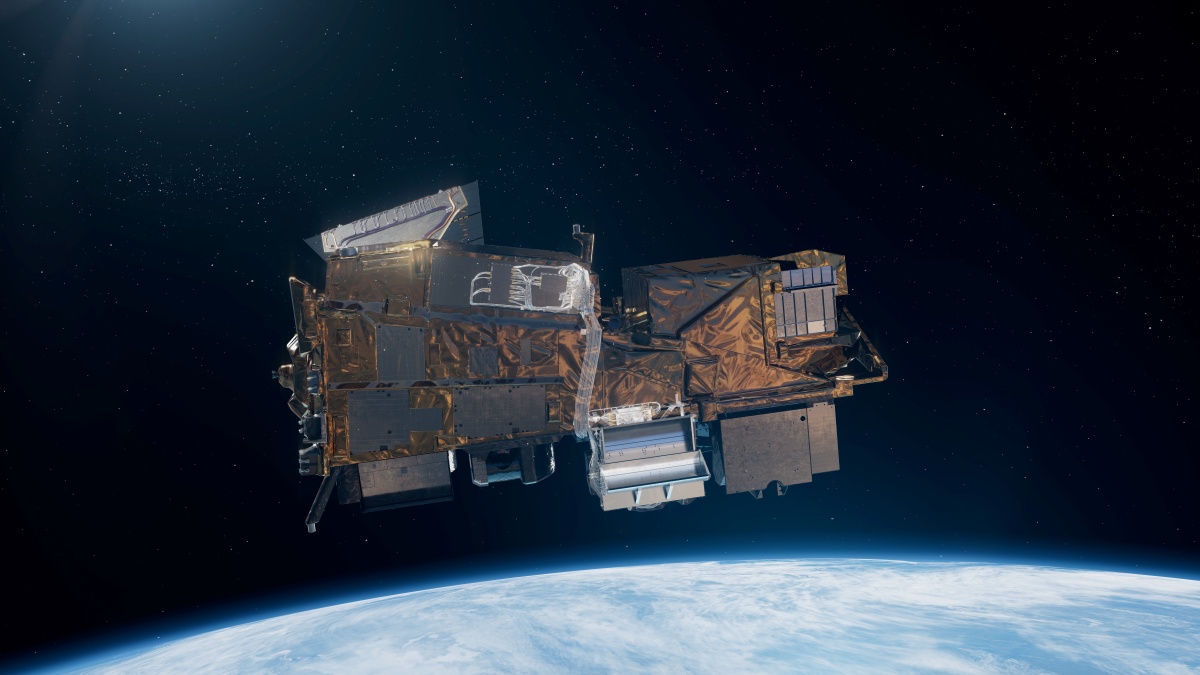
Artist impression of Sentinel-5A in orbit. Image courtesy of ESA/ATG medialab.
Last week saw the launch of the latest mission in the European Union’s Copernicus Programme, as Sentinel-5A was successfully delivered into a polar orbit onboard the MetOp-SG A1 satellite. The Ariane-6 rocket took off from the European Spaceport in Kourou, French Guiana in the early hours of 13th August (CEST) and placed the satellite in a sun-synchronous orbit at an altitude of 824 km.
Sentinel-5A
Sentinel-5A is a high-resolution passive grating imaging spectrometer with seven spectral bands, two in the ultraviolet range, one in the visible spectrum, two near-infrared, and two in the shortwave infrared range. The spectrometer has a spatial sampling resolution of 7.5 x 7.5 km for all the bands except the ultraviolet band, which is 50 x 50 km, and the instrument has a swath width of 2,670 km. It will orbit the planet every 100 minutes, enabling it to provide global coverage every day and has an expected mission life of 7.5 years.
Once calibrated it will collect daily data on atmospheric pollutants and trace gases including ozone, nitrogen dioxide, sulphur dioxide, formaldehyde, glyoxal, carbon monoxide, and methane, as well as aerosols and the ultraviolet index. The data will support environmental awareness with forecasts and public health alerts for air pollution, greenhouse gases, ultraviolet radiation, and aspects of climate; and, in policy terms, will directly support EU environmental initiatives, such as the Methane Strategy, the Ambient Air Quality Directive, and the Zero Pollution Action Plan. Senintel-5A is part of Copernicus’ wider atmospheric monitoring strategy, and will work together with Sentinel-4 satellite, the upcoming CO2 Monitoring Mission (CO2M) and alongside the existing Sentinel-5P mission, which has been very successful and was the precursor mission to Sentinel-5A.
This overall mission is a result of long-term co-operation between European Space Agency (ESA), the European Organisation for the Exploitation of Meteorological Satellites (EUMETSAT). The Metop-SGA1 satellite has six atmospheric sounding and imaging instrument missions onboard, in addition to Sentinel-5A it is carrying:
- Infrared Atmospheric Sounding Interferometer – New Generation (IASI-NG),
- METimage: a visual and infrared imager,
- Microwave Sounder,
- Radio Occultation Sounder, and
- Multi-Viewing, Multi-Channel, Multi-Polarisation Imager (3MI) – to enhance the monitoring of aerosols and cloud properties.
The data from the full suite of instruments will help meteorologists improve short- and medium-term weather models, and will support the early warnings of storms, heatwaves, and other disasters, in addition, it will help farmers to protect crops, grid operators to manage energy supply, and support navigation.
Conclusion
It is exciting to see the latest Copernicus launch, and the constellation continuing to build and develop the suite of satellites collecting environmental data. Andrius Kubilius, the EU’s Commissioner for Defence and Space, said after the launch that it showed Europe was a global leader both in terms of space and countering climate change. Given the recent developments in the USA, it certainly seems that the EU and China are likely to be the powerhouses of satellite data and climate change in the coming years.
