

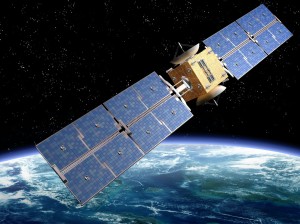
Artist’s rendition of a satellite – paulfleet/123RF Stock Photo
It’s been a roller-coaster of announcements for the UK Space industry, and our Earth Observation (EO) industry, over the last month.
It began on the 16th July with an announcement by the then Science Minister, Chris Skidmore, of a partnership between the UK Space Agency and NASA to work together on future lunar missions which brings a little closer the prospect of a UK astronaut walking on the moon. Although, some UK companies are concerned that this will allow the larger US space industry to take a greater proportion of UK space contracts.
In the same speech, the Minister highlighted the benefit of EO in monitoring the planet and its contribution towards green technology and supporting the net carbon emissions agenda. He also noted that EO contributed around £92 billion of economic activity to the country.
On the 24th July, on the steps of 10 Downing Street, the new Prime Minister Boris Johnson talked about EO in his inaugural speech. He stated ‘Let’s get going now on our own position, navigation and timing satellite and earth observation systems. UK assets, orbiting in space with all the long-term strategic and commercial benefits for this country.’ Normally these speeches are about improving peoples lives, improving the NHS, cutting crime and bolstering the economy; and to hear EO mentioned was a surprise.
There is also the UK National Space Programme, which aims to take forward UK space ambition and develop space capabilities with a range of international partners. It also hopes to run UK missions and commercialise scientific research, in effect, being the how to the Prime Minister and Science Minister’s what. It’s hoped to have funding of around £500 M over five years
So, it’s all going great in the UK EO industry right?
Not exactly. On the 9th August the Department for Business, Energy & Industrial Strategy and UK Space Agency released ‘Satellites and space programmes after Brexit – focusing on the No Deal position’. This document highlights the implications of Brexit specifically for Copernicus; Galileo and European Geostationary Navigation Overlay Service (EGNOS); and the EU Space Surveillance and Tracking (EUSST) programme.
Focusing on Copernicus, the statement which did not add much to what we already knew, notes that:
- The UK will no longer participate in the Copernicus programme.
- UK-based businesses and organisations will no longer be able to bid for future Copernicus contracts via the EU, ESA or EUMETSAT.
- The UK will lose access to data sourced by Copernicus from Contributing Missions.
- Some UK users will lose the right to high-bandwidth access to the standard data from the Copernicus Sentinels.
Currently, the Department for Environment, Food and Rural Affairs (Defra) leads the UK government on Copernicus policy, although interestingly that same department announced last week that it had signed a contract with Scisys to provide its Digital, Data and Technology Service (DDTS) to make raw satellite EO data available as a range of analysis-ready products for the department and its agencies.
For Galileo, the issues are similar in that the UK won’t:
- be able to use Galileo for defence or critical national infrastructure.
- have access to the encrypted Galileo Public Regulated Service.
- be able to play any part in the development of Galileo.
- be able to bid for future EU Galileo or GNSS contracts and may face difficulty carrying out and completing existing contracts.
Finally, in terms of the EU Space Surveillance and Tracking programme, the UK will:
- No longer be eligible to participate in the programme.
- No longer able to participate in scientific or technical groups or provide services.
If we return to the announcements from the Prime Minister and the Science Minister, the cost of developing our own fleet of ‘position, navigation and timing satellite and earth observation systems’, which is essentially our own Galileo and Copernicus, will cost millions and take years – so whilst the rhetoric is positive it’s far from clear whether this will turn into reality. Whilst the National Space Programme should be the vehicle for doing things, it does not yet have any committed funding and what support it receives will determine if these ambitions can be realised.
Of course, it’s not all negative. Even after Brexit UK organisations:
- can continue to use the free and open data of Copernicus – the same as anyone else in the world.
- can continue to be able to use the freely available ‘open’ signal for navigation and timing services provided by Galileo and EGNOS.
- will still be able to bid for Copernicus work tendered through ECMWF or Mercator Ocean or other similar programmes that use different procurement process to EU rules – although this isn’t the information we’ve previously received about this, so we’re curious to see how this pans out.
- will continue to receive space, surveillance and tracking data from the US.
- will still be a member of ESA and EUMETSAT.
The last point about ESA is going to be particularly interesting. In his speech on the 16th July, Chris Skidmore reaffirmed our commitment to ESA, and the UK contributes around £300 million each year – around 15% of the ESA budget. Given that ESA operates a geo-return principle that organisations within a country should receive contracts to the equivalent value of what the country contributes, it may mean UK companies will pick up a greater proportion of non-Copernicus contracts than previously.
The EO industry in the UK is in a delicate position. There are certainly going to be challenges in the coming years, and whilst certain current markets will be closed, there may well be opportunities elsewhere. Whether the UK EO industry will be worth £92 billion in five years, more than this, or less, is very much in the balance.
