

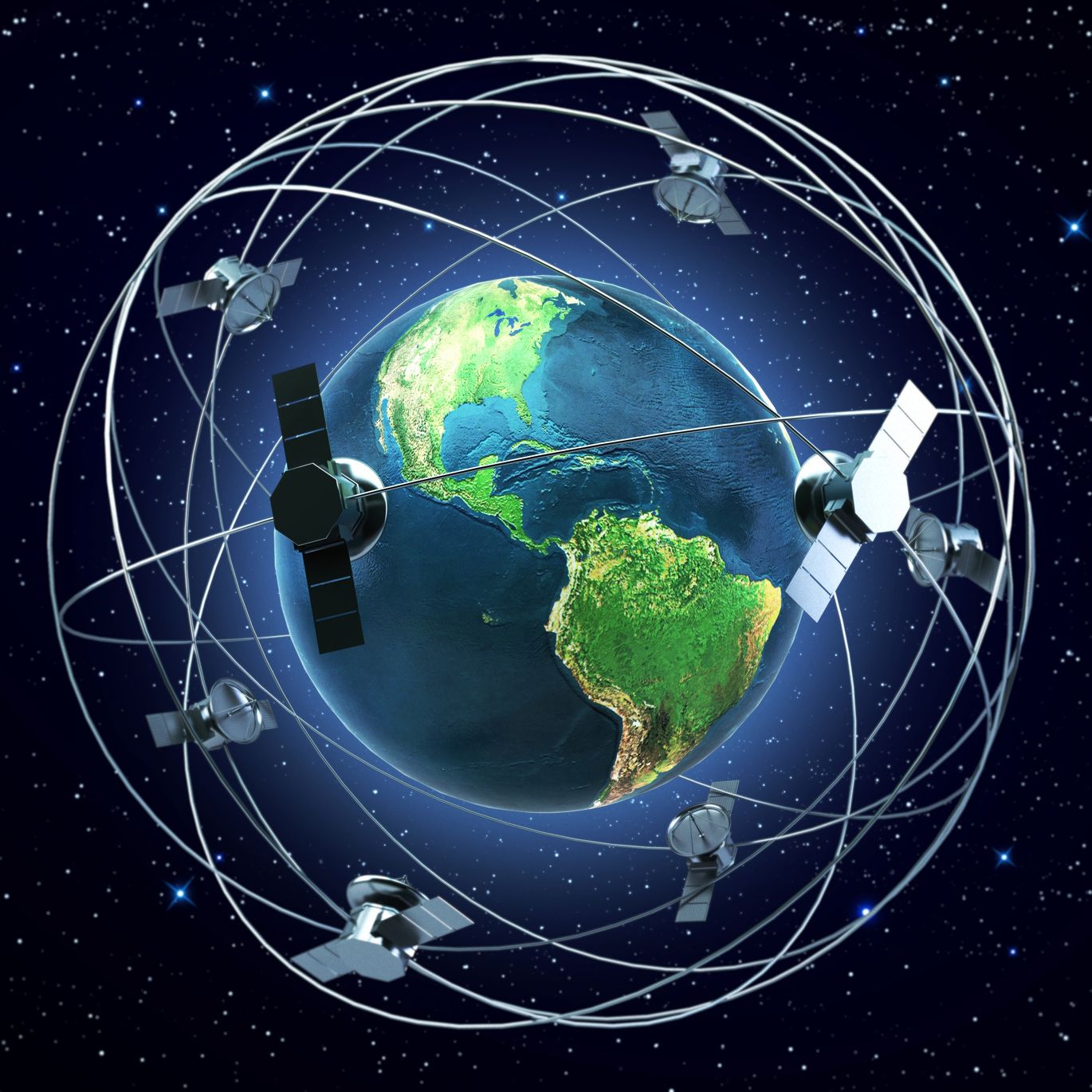
Artist’s rendition of satellites orbiting the Earth – rottenman/123RF Stock Photo
Earlier this year we wrote about our latest update on the number of satellites orbiting the Earth. One of the sources of this data is the Union of Concerned Scientists (UCS) who have just released their latest update showing the number of active satellites orbiting the Earth.
The UCS databases shows there were 2 787 operational satellites orbiting the Earth on the 31st July 2020. For this blog, we’re going to focus specifically on the subset of operational satellites relevant for Earth Observation (EO).
Within the database there are 815 operational satellites that have either EO or Earth Science as their main purpose. However, that’s not the end of the story. There are 42 satellites who have either Communications or Technology Demonstration/Development as their main purpose, but looking at the detailed purpose tells a slightly different story as these satellites are being used for:
- Earth Science – 6 satellites
- Hyperspectral Imaging – 8 satellites
- Infrared Imaging – 2 satellites
- Optical Imaging – 22 satellites
- Radar Imaging – 4 satellites
Adding these two sets of figures together gives a total of 857 individual active satellites being used for EO, which is 30.75% of the total active satellites currently orbiting the Earth. For the rest of this blog we’re going to investigate this set of satellites further.
Who owns and operates these Earth observation satellites?
It is recognised that a significant proportion of the EO satellites are small cubesats. Looking at the top owners/operators of these EO satellites demonstrates this, as Planet are by far the biggest owner/operator of satellites, followed by the Spire Global constellation. Between them, these two USA organisations account for over one-quarter of all the EO satellites at 27.89%. The top five are:
- Planet Labs, Inc. – 151 satellites
- Spire Global Inc. – 88 satellites
- China’s People’s Liberation Army – 67 satellites
- USA’s National Reconnaissance Office (NRO) – 42 satellites
- Indian Space Research Organization (ISRO) – 19 satellites
In terms of country ownership, the results are unsurprising with the USA leading, followed by China, Japan and Russia:
- USA – 370 satellites
- China – 191 satellites
- Japan – 36 satellites
- Russia – 34 satellites
- India – 25 satellites
Amazingly, these five countries control over three quarters of all active EO satellites. In sixth place is the European Space Agency, with 15 satellites including the Copernicus missions.
What do Earth observation satellites do?
Whilst the 857 satellites we are looking at today have a purpose of EO or Earth Science, there are further details on their specific roles. So we have:
- Optical Imaging: 333 satellites
- Meteorology: 134 satellites
- Earth Science: 73 satellites
- Electronic Intelligence: 65 satellites
- Radar Imaging: 63 satellites
- Hyperspectral/Multispectral Imaging: 39 satellites
- Automatic Identification System (AIS): 14 satellites
- Infrared Imaging: 10 satellites
- Other purposes: 8 satellites.
- 118 satellites simply list EO as their purpose
Although, it should be noted that some of the satellites have more than one role.
Who uses the Earth observation satellites?
The users for the EO satellites listed by the UCS are:
- 40.96% of users are Commercial users
- 32.91% of users are Government users
- 22.40% of users are Military users.
- 3.73% of users are Civil users
Again, it should be noted that some of these satellites have multiple users.
Earth Observation Satellite Facts!
- The oldest active EO satellites reported are:
- TDRS-3 : a NASA tracking and Data Relay satellite which is listed as Communications satellite, which undertakes optical imaging, which was launched on the 29th September 1998; or
- SCD-1: a Brazilian EO satellite focusing on Meteorology/Earth Science, which was launched on the 9th February 1993.
- Most Active Launch Day for Operational EO Satellites:
- 14th July 2017 saw 43 EO satellites launched. The majority of these were Planet satellites, but this day also included launches for Spire Global, Tyvak Nanosatellite Systems, Norwegian Space Center, Roscosmos, University of Stuttgart & Axelspace.
- Interestingly, the second most active day was also in 2017 when 40 Planet satellites were launched on the 14th February.
- Orbits
- Unsurprisingly, over 90% of the EO satellites are in Low Earth Orbits, with 7.7% in Geostationary orbits and the remainder in elliptical orbits.
What’s next?
This year has seen a reduction in the amount of EO satellites launched, although China has regularly launched and India is looking to restart launches soon. The satellite launches this year have been dominated by the Starlink satellite broadband constellation.
There are some exciting launches ahead for the rest of the year including Falcon Eye 2, RISAT 2BR2, Sentinel-6 Michael Feilich, SEOSat-Ingenio, Taranis, GISAT-1! It is clear that the amount of EO data available is going to continue to grow!
