

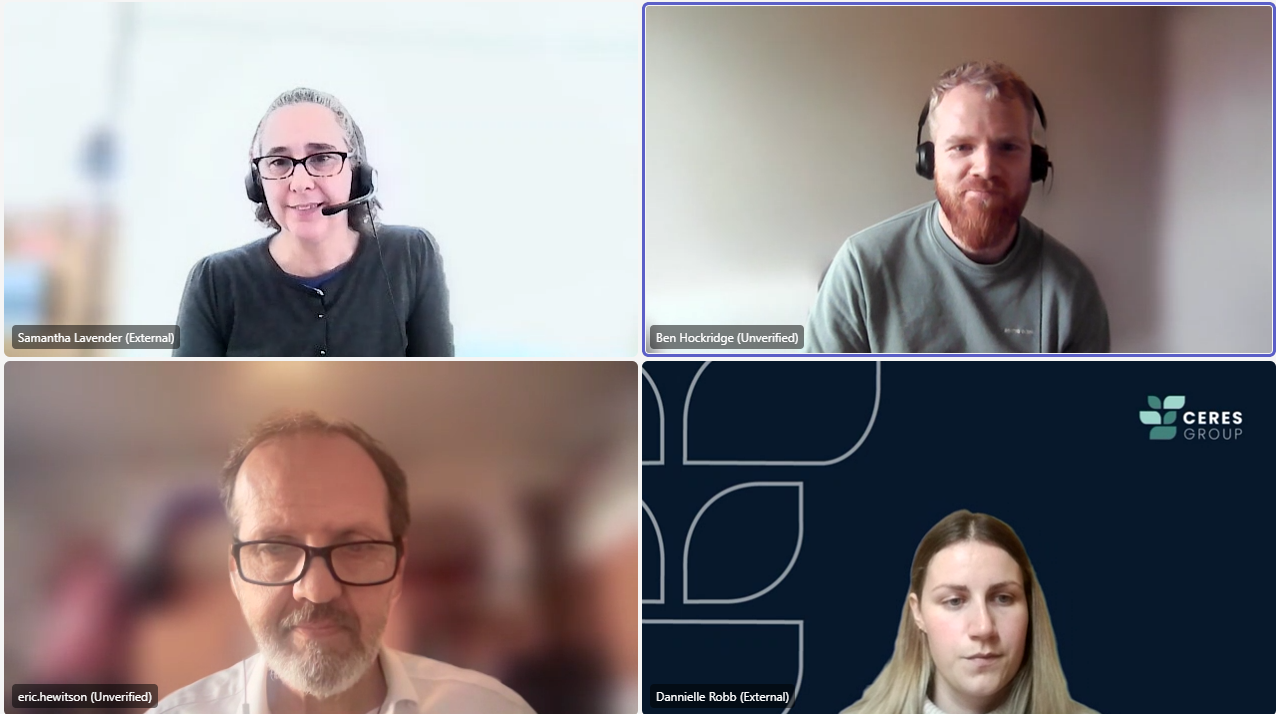
Presenters at the webinar. Image courtesy of Thomas Wedd, Agri-TechE
Earlier this week we hosted a webinar titled ‘Climate Adaptation in Agronomy with Satellite Technology’ as part of the 2025 Agri-Tech Week, which is run by Agri-TechE. With almost one hundred attendees signed up it was shaping up to be an exciting event … and then the Amazon Web Services outage on Monday morning began a couple of hours before our event was due to start and took out some of the applications we were using, and to cut a long story short, the outage meant none of the delegates could join the event.
All the presenters had arrived and in the best traditions of ‘the show must go on’, they did the whole presentation to an audience of one – me actually! However, the whole event was recorded and so on the video below everyone can watch the fantastic talks and discussions from the day.
The webinar began with an introduction to Agri-TechE, and their Agri-Tech week, by Thomas Wedd, after which we had the following four presentations:
- Pixalytics’ Managing Director, Dr Samantha Lavender talked about the Space4Climate Market Breakthrough project we’re involved, in which is aiming to understand the use of space-based technology by stakeholders delivering ‘the last mile’ of innovation to farms, including advisors, agronomists, farm management platforms, and machinery providers. Sam talked about what we had discovered in our conversations and interviews this summer, including the results of a survey we have been running – it is still available if you would like to add your thoughts.
- Ben Hockridge from ADAS talked about a real-world example of using satellite imagery within agriculture by highlighting the PeaSat project. Pea growers have a small window of a couple of days for harvest, and this project used a combination of cloud free Sentinel-2 satellite data, weather data, field sizes, and cropping information as inputs into machine learning models to predict vining pea yields. This tool should help growers and processors better manage their harvesting timetable, and it’s forecast that this could reduce the amount of wasted crop by 3,060 tonnes of peas each year, worth a value of €1.8 million across the country that will help support sustainable agronomy.
- Eric Hewitson from Lacuna Space talked about the role of Internet-of-Things (IOT) sensors and how Low-Earth Orbit (LEO) satellites provide essential, low-data connectivity for low power remote sensors such as temperatures, soil moisture, and livestock tracking around farms. This is particularly valuable as 85% of the Earth’s surface has no cellular coverage, and these types of satellites solve this problem and offer potential savings in terms of water usage and yield stability for crops that will help producers approach to sustainability and climate adaptation.
- Dr Dannielle Robb from Ceres Research was the final presenter and she talked about data management on farms. She began by highlighting that farmers have access to a huge amount of data and the critical element is storing, integrating, and turning the data into useful information to support decision making in their businesses; and gave an example of this process for managing greenhouse gas emissions. A second example focused on integrating various data sources into a single dynamic reporting dashboard to help farmers make better decisions. One important final note from Dannielle highlighted that artificial intelligence and machine learning need to complement farmer’s wisdom, not replace it.
After the talks there was a panel discussion, which covered topics including whether AI is positive or negative for the future of farming, the technical and social issues of data sharing within agriculture, and longer-term challenges of climate adaptation. The full webinar can be seen below:
Despite the challenges, this has provided to an interesting and thought-provoking webinar both highlighting some of the positive potential for space-based technology in farming, but also discussing the current challenges including connectivity, data volumes, turning data into useful information, support and training.
At the start of Dannielle’s talk as her presentation was coming up, she gave us our theme for the day by noting that ‘Better Connectivity needed’! This was both a reminder of the reliance and expectation we have for the internet to work, together with the challenges for farmers working in fields without mobile phone coverage.
While it was not how we planned the session, we are hugely grateful to Ben, Eric and Dannielle for their presentations, together with Agri-TechE for all their help and support with this webinar and encourage everyone to watch the recording.
