

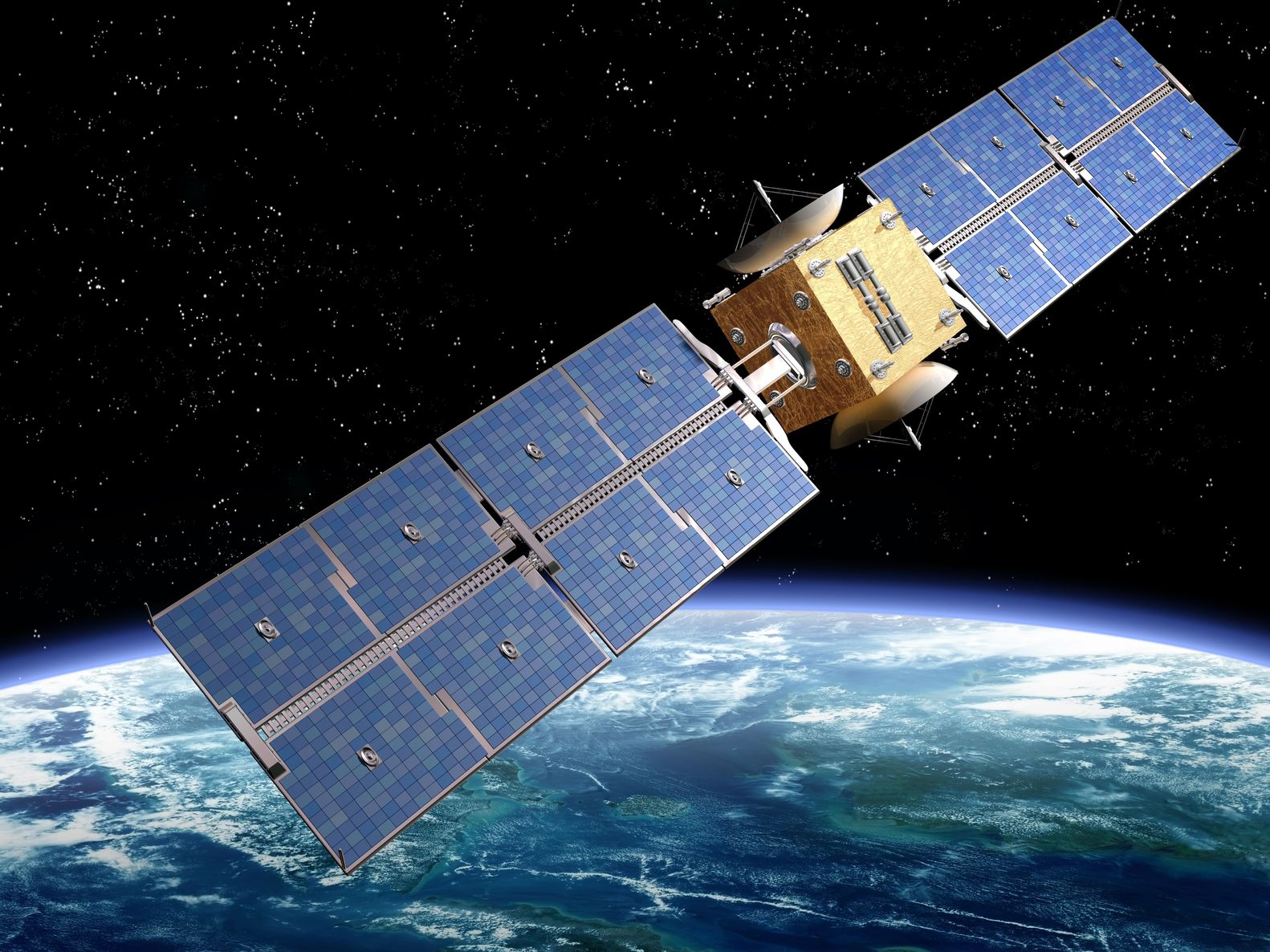
Artist’s rendition of a satellite – paulfleet/123RF Stock Photo
*** Please Note: Whilst the rocket took off as expected, the satellite was not put into orbit due to a technical issue at Cryogenic Upper Stage in the seventh minute of the launch. The rocket and the satellite were lost ***
This week we’re focusing on the latest development of space capability for India, with the announcement by the Indian Space Research Organisation that they are planning to launch the GISAT-1 Earth Observation (EO) satellite, also known as EOS-03, on Thursday 12th August 2021 from the Satish Dhawan Space Centre via the Geosynchronous Satellite Launch Vehicle-F10 (GSLV-F10).
GISAT-1 will be India’s first EO satellite to be placed in geostationary orbit at approximately 36,000 km above the planet, with the high point at 36,297 km. It will be capable of constantly monitoring key areas of interest, with the whole country four or five times a day and the entire Indian sub-continent three or four times every day.
The mission objectives are:
- To provide near real-time imaging of a large area region of interest at frequent intervals
- For quick monitoring of natural disasters, episodic events and any short term events
- To obtain spectral signatures for agriculture, forestry, water bodies as well as for disaster warning, cyclone monitoring, cloud burst/thunderstorm monitoring etc.
The satellite will carry both multispectral and hyperspectral imaging instruments. The six band multispectral imager will operate in the visible and near infra-red (IR) bands with 42 m spatial resolution; whilst it will also have 158 bands hyper-spectral visible and near IR with 318 m spatial resolution together with 256 bands hyper-spectral shortwave IR with 191 m spatial resolution. With a lift-off mass of 2 268 kg, this is a large satellite and it has an expected mission life of ten years.
Originally, GISAT-1 was due to launch in March 2020 but was postponed due to a technical issue, after which the global pandemic delayed the mission into 2021. Another launch was planned for March 2021, but this was also postponed due to a problem with the satellite’s battery. In a real moment of déjà vu, future launched dates were again delayed due to the second wave of the pandemic in India.
However, it is due to go up this week and like China, as we discussed a couple of weeks ago, India is developing into a powerful EO nation. ISRO itself states that they already have control of one of the largest EO constellations in the world, and this will not stop with GISAT-1.
ISRO is planning to launch RISAT-1A next month, which will be a SAR imaging satellite to complement the optical GISAT-1, and is expected to put another three EO satellites into orbit this year. In addition, GISAT 2 is expected to be launched next year and will be identical to its predecessor.
All of this shows how fast things are moving and changing in the EO community.
