

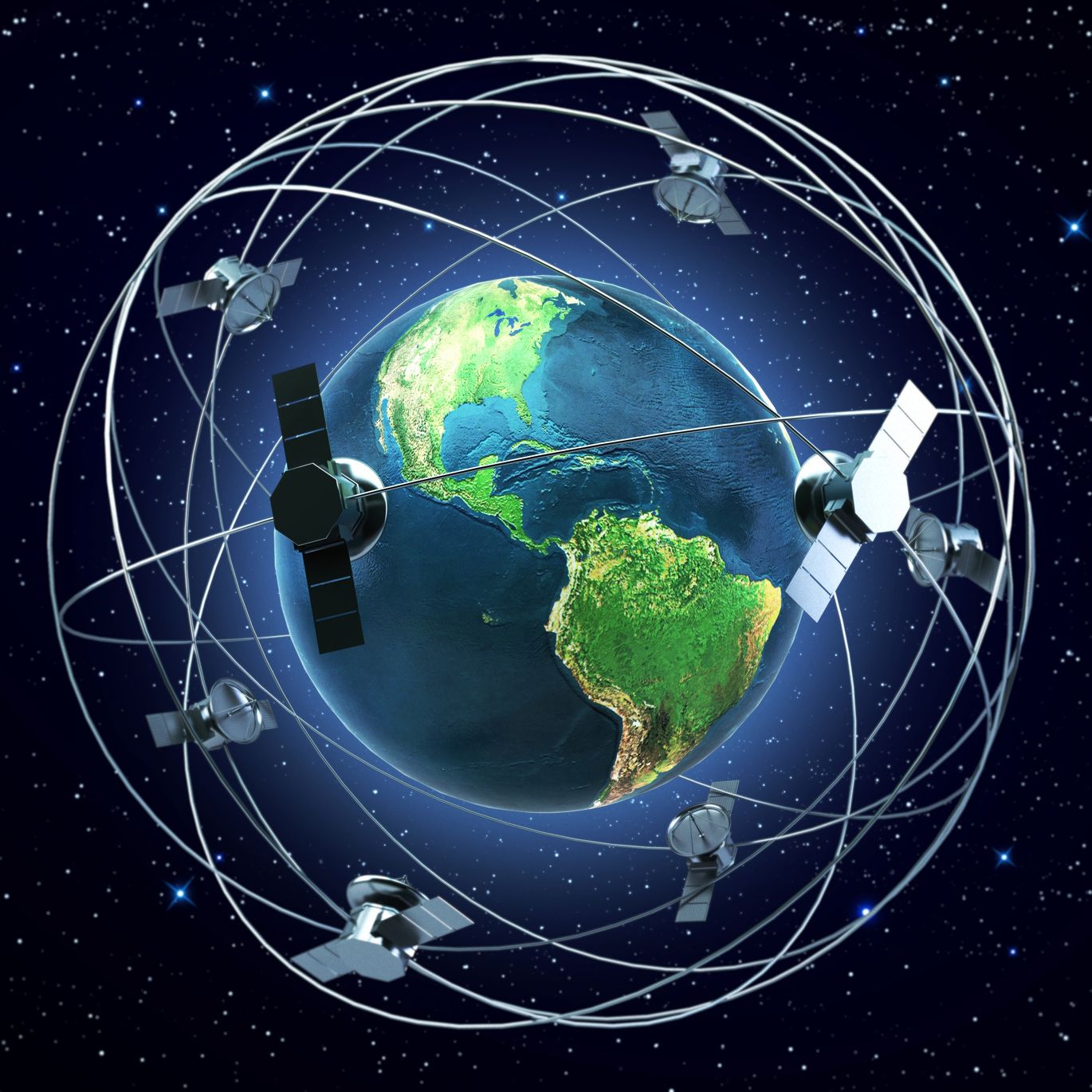
Artist’s rendition of satellites orbiting the Earth – rottenman/123RF Stock Photo
An updated version of this post for 2022 can be found here.
How many satellites are orbiting the Earth?
According to the Index of Objects Launched into Outer Space, maintained by the United Nations Office for Outer Space Affairs (UNOOSA), there were 7 389 individual satellites in space at the end of April this year; an increase of 27.97% compared to 2020.
Whilst many industries have struggled over the last year with the global pandemic, the satellite launch business does not seem to have suffered the same impact. Last year saw the largest number of satellites ever launched in a single year with a figure of 1 283, which is more than double the amount in any other year since records began.
We’ve also not seen any sign of the pace decreasing and that record number of launches is likely to be exceeded again this year – by the end of April almost 850 satellites had been launched, and in the first half of this month another 180 have been sent up, so it is a case of if not when the 2020 record will be smashed!
The growth of objects going into space
Putting this growth into context, the first object launched into space was SPUTNIK-1 on the 4th October 1957, and in the sixty-four years since we were able to do this, according to UNOOSA, 11 139 objects have been launched into space up until the end of April 2021; yet one-third of those launches occurred in the last five years!
The growth of satellites over the last decade was driven by the development of the smaller CubeSat, which allows a large number of satellites to be launched at the same time, whereas historically rockets only launched one or two satellites at a time.
Initially, Earth Observation took advantage of this opportunity of launching satellite constellations, such as those owned by Planet, to enable much more frequent monitoring of the Earth. However, in recent years it is the race for satellite broadband services that have driven the growth – in particular the SpaceX Starlink satellite constellation. During this month there have been 172 Starlink satellites put into orbit on three launches, making their constellation over 1 600!
This is phenomenal, it took the entire world twenty-five years to launch this many, but now a commercial company has done that in a few years. It is not just Starlink who are launching larger numbers, the UK Government part-owned OneWeb has launched 72 satellites this year.
There are also further companies planning to launch large satellite broadband constellations, such as Kuiper, a subsidiary of Amazon, looking at a constellation of a few thousand; and Lightspeed, from Canadian company Telesat, planning a constellation of several hundred.
All of the orbiting satellites are working, aren’t they?
As we noted earlier, of 11 139 objects launched into space UNOOSA records indicate there are 7 389 satellites in space at the moment, the rest have burnt up in the atmosphere as most CubeSats do, or have returned to Earth in pieces – like the recent Chinese Long March 5C rocket which crashed into the Indian ocean.
Of course, not all the objects in space are orbiting Earth, a small number are orbiting other planets. However, you’d expect that the majority of the satellites orbiting the Earth would be operational, wouldn’t you? Well, you’d be wrong!
The Union of Concerned Scientists (UCS) keeps a record of the operational satellites and their latest update provides details to the end of December, and for the next section, we’ll be using the end of December figures from both UNOOSA and UCS to give figures. As we’ve already indicated things change fast and so the figures here are a little out of date, but this indicates the position.
From the UNOOSA database as of the 31st December 2020, 6 542 objects were orbiting the Earth, and according to UCS at the same point, there were 3 372 active satellites, or 51.54%, which means just under half the things flying around the world at 38 000 miles per hour are simply hunks of useless metal doing nothing!
What are all these satellites doing?
Using the UCS update, as at the end of December, the main purposes for the operational satellites are:
- Communications: 1 832 satellites – increase of 51% since March 2020.
- Earth observation: 906 satellites – increase of 2.5% since March 2020.
- Technology development/demonstration: 350 satellites – increase of 12% since March 2020.
- Navigation/positioning: 150 satellites – increase of 1% since March 2020.
- Space science/observation: 104 satellites– increase of 12% since March 2020.
- Earth science: 20 satellites – a decrease of 11% since March 2020.
- Other purposes – 10 satellites.
It should be noted that some of the satellites have multiple purposes, and they have been categorised by their main purpose.
This summary simple reinforces the point that satellite broadband communication satellites are driving the global growth of satellites in space.
Who operates the most satellites?
According to the UCS database, the top ten countries with the most operational satellites are:
- USA
- China
- Russia
- United Kingdom
- Japan
- India
- European Space Agency
- Canada
- Germany
- Luxembourg
ESA satellites are essentially satellites launched on behalf of a conglomerate of nations. For those wondering why Luxemburg is so high up the list, the majority, but not all their satellites, are owned by the SES S.A. satellite and telecommunications network provider
Who are the users of the satellites?
Looking at the primary users of satellites gives:
- 2 092 satellites are listed as having commercial users
- 613 with government users
- 508 with military users; and
- 154 with civil users.
It should be noted this list is the primary user of the satellite, of these, there are 303 satellites (8.99%) listed as having multiple users groups.
When you look up at the night sky ….
Remember that there are thousands of objects orbiting the planet. The orbits of these are:
- 2,612 in a Low Earth Orbit.
- 139 in a Medium Earth Orbit
- 562 in a Geo-stationary orbit
- 59 in an Elliptical orbit.
Interestingly, if you look carefully, it is possible to see some of these objects from Earth with the naked eye. Famously, it is possible to see the International Space Station and now the Starlink constellations are also visible and can be seen as strings of lights travelling at the same orbit and so following right after each other. Each constellation is a string, normally starting with 60 satellites in the initial string, and so it possible to see a number of these constellations throughout the night. They are causing reports of UFOs from concerned people who see them in the sky and don’t know what they are.
So, find a dark place, without too much light pollution, and look up. You never know what you might catch a glimpse of!
