

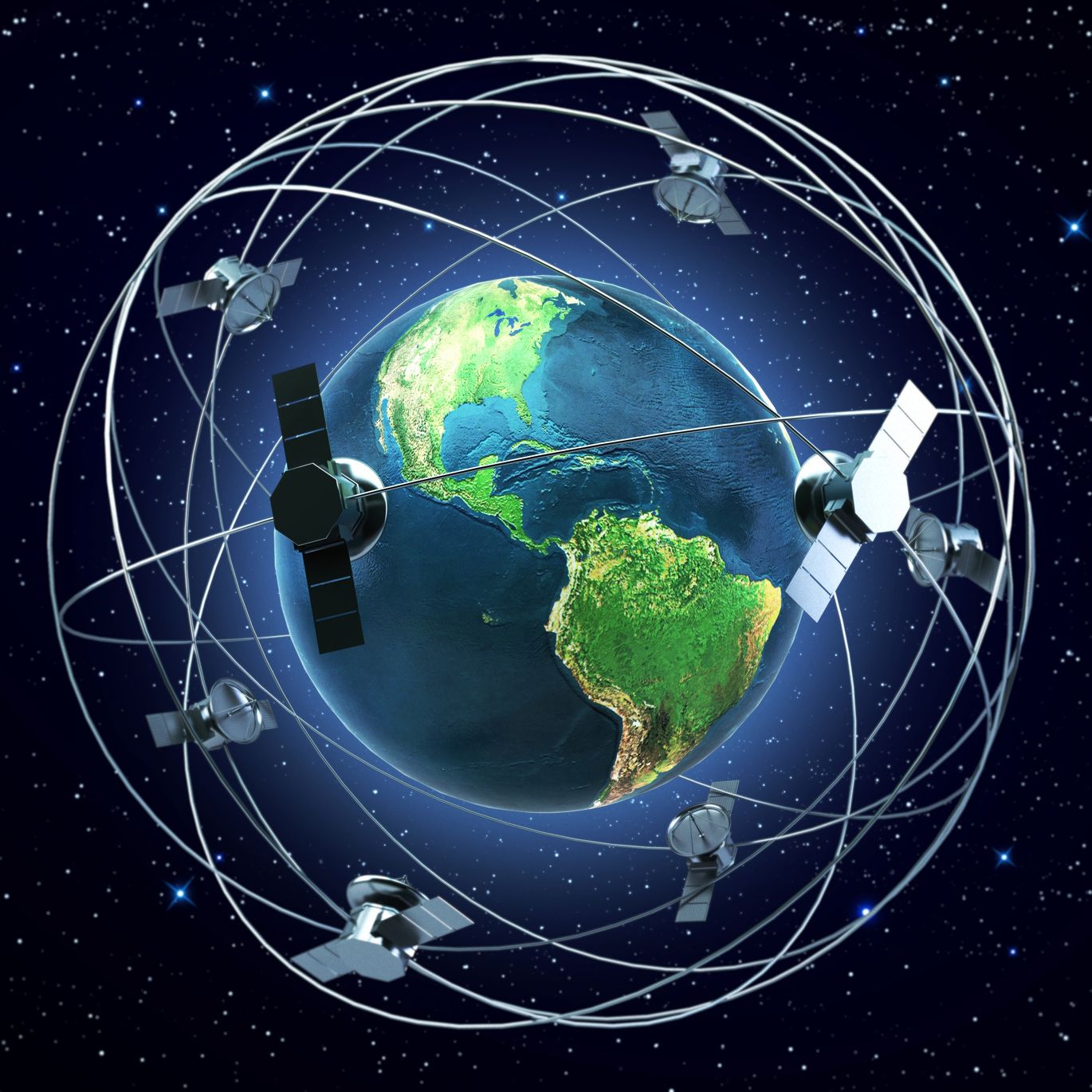
Artist’s rendition of satellites orbiting the Earth – rottenman/123RF Stock PhotoAn updated
An updated post for 2023 can be found here!
According to the Index of Objects Launched into Outer Space, maintained by the United Nations Office for Outer Space Affairs (UNOOSA), there were 8 261 individual satellites orbiting the Earth at the end of January; an increase of 11.84% compared to April 2021.
Last year saw a record number of objects launched into space, with 1 807 leaving the planet in 2021; a 41.84% increase compared to 2020. To give context to this, during 2020 and 2021 there were 3 081 objects launched into space, which accounts for approximately 25% of the objects ever launched. Following the first launch in 1957, it took almost 25 years to reach the number of launches in the last two years. On a simple quantitative level, this demonstrates the growth and development of the space industry in recent times. The growth will continue with 179 objects launched in January alone!
Where have all these objects in space been launched from?
To the end of January 2022, there have been 12 293 objects launched into space, and there are 31 different launch facilities listed by UNOOSA, including air-based, sea-based and even submarine-based launches. There are also space-based launches from the international space station. The top five launch sites are:
- Cape Canaveral in the United States with 3 509 launches.
- Plesetsk Cosmodrome in Russia with 2 150 launches.
- Baikonur Cosmodrome in Kazakhstan with 1 975 launches.
- Vandenberg Air Force Base in the United States with 1 229 launches.
- Centre Spatial Guyanais in French Guiana with 616 launches.
In addition to these sites there have also been launches from China, India, Japan, South Korea, North Korea, New Zealand, Algeria, Australia, Israel & Iran.
It is hoped that the UK will be added to this list with the next blog update. Spaceport Cornwall are on track to deliver the first horizontal satellite launch this summer, and Saxavord Spaceport in the Shetlands Islands, Scotland, are moving forward with their vertical take-off facilities and hope to launch a meteorological satellite this year.
All of the orbiting satellites are working, aren’t they?
As we noted earlier, of all the objects launched into space UNOOSA records indicate there are 8 261 satellites currently orbiting the Earth at the moment. There are also over 100 objects orbiting other bodies such as the Moon, Mars, etc. The difference to the number of objects launched are those that have either returned to Earth, or burnt up in the atmosphere as most CubeSats do.
You may be surprised to know that not all of the satellites currently orbiting the Earth are working. In fact, according to the Union of Concerned Scientists (UCS) who keeps a record of the operational satellites noted that there were only 4 852 active satellites at the end of December, or equivalent to approximately 58% of the satellites orbiting the Earth.
Or to put it another way, almost 42% of the objects currently orbiting the Earth are simply useless hunks of metals – this is around 3 500 objects!
As we mentioned things move quickly in the space industry, and there is a difference of a month between the UNOOSA and UCS figures, and for the next section, we’ll be using the end of December figures from UCS.
What are all these active satellites doing?
Using the UCS update, as at the end of December, the main purposes for the operational satellites are:
- Communications: 3 135 satellites – increase of 71.12% since December 2020.
- Earth observation: 1 030 satellites – increase of 13.69% since December 2020.
- Technology development/demonstration: 385 satellites – increase of 10% since December 2020.
- Navigation/positioning: 154 satellites – increase of 2.67% since December 2020.
- Space science/observation: 108 satellites– increase of 3.85% since December 2020.
- Earth science: 22 satellites – an increase of 10% since December 2020.
- Other purposes – 18 satellites.
It should be noted that some of the satellites have multiple purposes, and they have been categorised by their main purpose.
Overall, since December 2020, the number of active satellites has increased by 43.89%. The next section will look at what is driving this increase.
Who operates the most satellites?
Looking at who operates the greatest number of satellites gives a clear insight into the growth in numbers. The top ten operators of the greatest number of satellites are:
- SpaceX – 1 815 satellites. These are the Starlink satellite broadband constellation, owned by Elon Musk’s American company, which last week was activated over Ukraine.
- OneWeb – 394 satellites. OneWeb’s satellite internet constellation, the UK based satellite broadband company.
- Planet Labs – 188 satellites. These are Earth Observation satellites for this American company, the majority of which are the Dove CubeSats.
- Chinese Ministry of National Defense – 134 satellites. These are a combination of the Beidou global positioning/navigation, and the Yaogan Earth Observation constellations.
- Spire Global – 120 satellites. These are Earth Observation satellites for this American company that are further defined as delivering Meteorology and Automatic Identification System (AIS) data.
- Swarm Technologies – 119 satellites. These are satellite broadband communication satellites for the US company, known as the SpaceBEE constellation.
- Russian Ministry of Defence – 109 satellites. Combination of satellites for Communication, Earth Observation and Navigation.
- Iridium Communications – 75 satellites. These are communication satellites for this American based company.
- SES SA – 48 satellites.These are communication satellites for a commercial company based in Luxembourg.
- Indian Space Research Organisation (ISRO) – 44 satellites. This is India’s national space organisation, and they have orbiting satellites undertaking a wide range of roles include Communication, Earth Observation, Navigation and Positioning, Space Science & Technology Development.
Looking at the operators in detail, it reinforces the fact that the current driver of growth is the space-based broadband sector. These operators are expected to continue to launch satellites to enhance their constellations and new players will also come into the market, meaning that the increase in satellite numbers highlighted at the start of the blog will likely continue to rise.
Who are the users of the satellites?
Looking at the primary users of satellites gives:
- 3 094 satellites are listed as having commercial users – again driven by the space-based broadband companies.
- 653 with government users
- 553 with military users; and
- 156 with civil users.
It should be noted this list is the primary user of the satellite. Of these, there are 302 satellites (6.22%) listed as having multiple users.
When you next look up at the night sky ….
Remember that alongside all of the amazing stars there are thousands of active, and inactive, satellites orbiting the planet and this number is increasing rapidly.
