

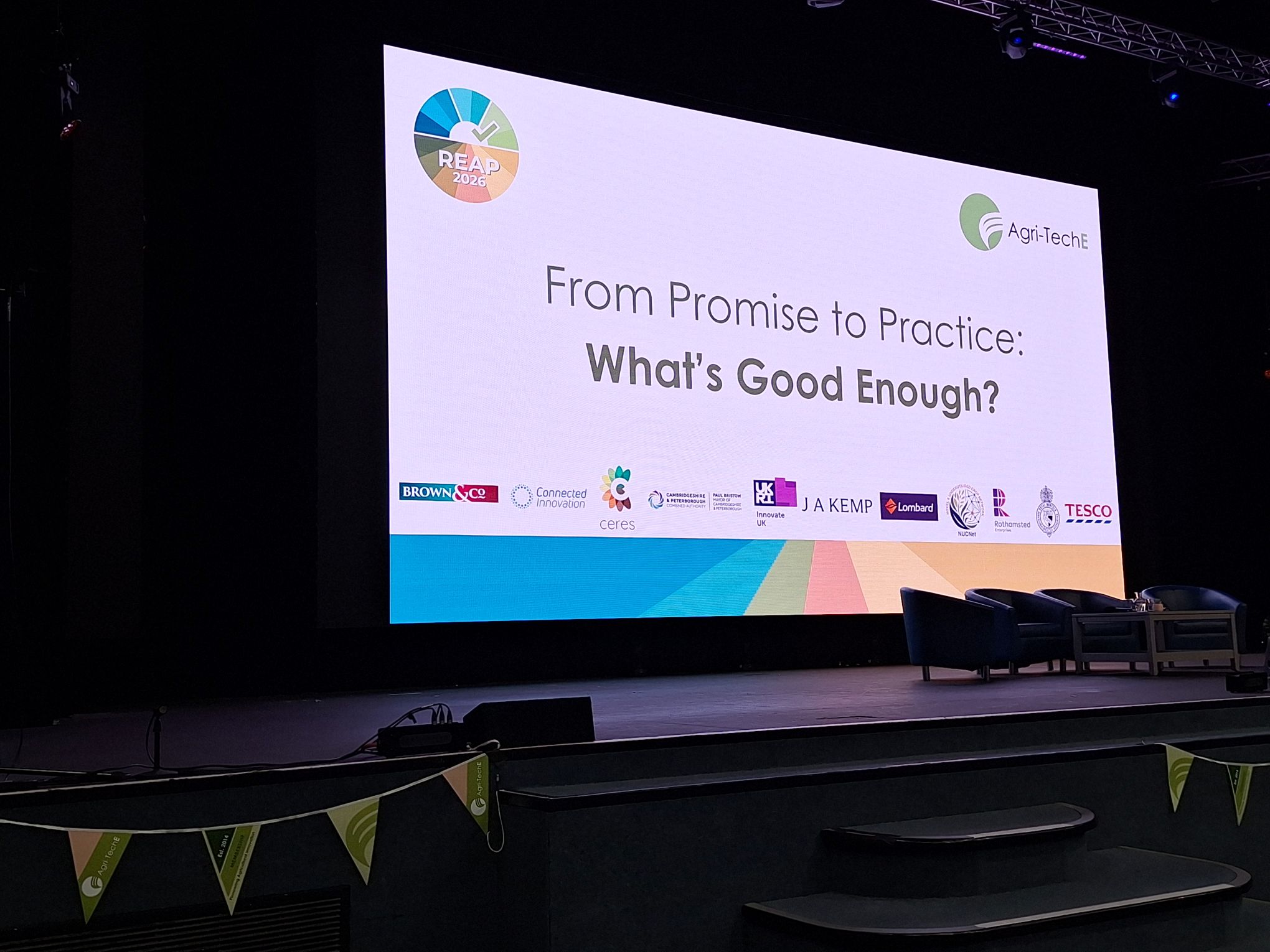
 Last week saw the annual Agri-TechE REAP 2026 conference that brings together agri-tech researchers and innovators with farmers and other agriculture stakeholders from across the UK. The one-day event took place on the 4th November and was held at the Kingsgate Conference Centre in Peterborough, and this year’s theme was ‘From Promise to Practice: What’s Good Enough?’ looking at agricultural innovation and focusing on the question when is something good enough for widescale adoption?
The conference was opened by Dr Helen Ferrier, Director of Innovation & Knowledge at the Linking Environment And Farming (LEAF) organisation and chair of the Agri-TechE Stakeholder Group. She welcomed everyone to the conference, and discussed the current challenges facing agriculture, including heat, drought, and energy prices, and the need for confidence to invest. She highlighted that often the need for perfection of something new was paralysing innovation; so instead, continuous improvement should be the focus.
The keynote speaker Prof Anjali Goswami, Defra Chief Scientific Adviser, followed and she described natural systems as big, complex, and messy and where data gaps exist, the industry need to understand them to decide whether they’re important to fill. She also described the importance of being adaptive and taking small steps, and that inaction also carries risks. Her focus has been on developing a systems perspective that minimises uncertainties rather than aiming to remove them. In the Q&A session, farming was described as very risk-aware, but that innovation take-up could be faster.
The next session was the farmer insights panel, where we heard from businesses that are supporting and using innovative approaches to managing pests and diseases without chemicals. While these new approaches still need further innovation work is being undertaken on breeding disease-resistant crops and using natural chemicals and phages.
This topic was further explored in the session after the break, where researchers showcased their current activities. There was also a discussion regarding the need for agronomists to adapt to a changing role – supporting efficient and accurate data collection and analysis, while not losing traditional skills such as knowledge about pests & disease. One of the research-into-practice talks I found particularly of interest was from Joe Collins of Harper Adams University. It was the use of seismology to understand soil structure and compaction, and the aim is to use the accelerometers on mobile phones to undertake the measurements – place your phone on the floor and work around it. So, this would be a low-cost sensor the farmer could already be carrying.
Lunch, and the morning and afternoon coffee breaks, were opportunities for networking. Last year, Pixalytics had their own stand as we were promoting and talking about our Space4Climate Market Breakthrough project that we were working on at the time. This year, rather than having our own stand, we supported the Space4Climate stand.
In the afternoon, I enjoyed the Start-Up Showcase which began with focusing on start-up organisations looking to transform the future of farming; interestingly the ‘Beyond the Showcase’ element of the session highlighted businesses that had previously presented to the Start-Up Showcase, and they described what had happened since and where they are heading next. Topics in this session included measuring temperature to see when plants are sick and cows are lame, using a blue light on a robot to zap weeds, and turning manure into fertiliser through anaerobic digestion.
Summary
It is always good to see cutting-edge agri-tech research and what is happening in the sectors we operate in, and the REAP conference was no different. It certainly gives food for thought on new approaches, techniques, or uses for satellite data. I have a few new ideas for what Pixalytics might explore in the coming year!
