

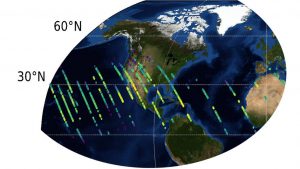
Preliminary carbon dioxide (CO2) measurements from OCO-3 over the United States.
Image Credit: NASA/JPL-Caltech
The first images from NASA’s Orbiting Carbon Observatory-3 (OCO-3) were released recently. The team working on the measurements, taken at the end of June, were able to make their first assessments of carbon dioxide and solar-induced fluorescence — the “glow” plants emit from photosynthesis, which also includes carbon capture from the atmosphere.
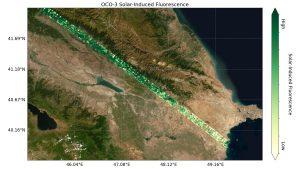
Preliminary solar-induced fluorescence (SIF) measurements from OCO-3 over western Asia
Image Credit: NASA/JPL-Caltech
The first image shows the carbon dioxide (CO2) over the United States, whilst the second shows solar-induced fluorescence in western Asia shown to the left.
The difference is noticeable from the low vegetation near the Caspian Sea to the forests and farms towards the top of the image. These initial results are similar to those measurements taken over this area by its predecessor OCO-2. This is important as one of the mission objectives of OCO-3 is to continue the five-year data time-series of OCO-2 – even though OCO-2 is still in operation.
OCO-2 is more than just the predecessor as OC-3 was built with the spare instrument from OCO-2. It consists of three high-resolution spectrometers integrated into a common structure and illuminated by a telescope. One spectrometer measures how much sunlight the oxygen in the atmosphere has absorbed, and the other two measure sunlight absorption by carbon dioxide at two different sets of wavelengths. The ratio of carbon dioxide to oxygen is then used to determine the concentration of atmospheric carbon dioxide. OCO-3 is also equipped with a new pointing mirror assembly allowing scientists to map local variations in carbon dioxide.
OCO-3 was sent up to the International Space Station on the 4th May 2019 in the unpressurized portion of a SpaceX Dragon spacecraft on a Falcon 9 rocket. On arrival, it was deployed on the external Japanese Experiment Module – Exposed Facility (JEM-EF), which holds a number of instruments taking measurements of the planet. This will allow OCO-3 to see the same location on the planet at different times of the day. This contrasts with OCO-2 as it orbits the Earth in a near-polar orbit at an altitude of 705 km.
OCO-3 is still in its calibration phase, and it’s not scheduled to release its data to the scientific community until 2020. The mission is expected to have a three-year life, although as we can see from OCO-2 it may be extended.
OCO-3 joins other instruments on the JEM-EF including two we’ve written about before
- ECOsystem Spaceborne Thermal Radiometer Experiment on Space Station (ECOSTRESS) mission which is hoping to improve our understanding of how much water different plants and crops require to stay healthy; and
- Global Ecosystem Dynamics Investigation (GEDI) mission which is creating detailed 3D maps of the Earth’s forest and topography using lasers
It is hoped that combining the data from these two instruments with OCO-3 will provide a greater understanding of how plants are responding to changes in climate and a more complete understanding of the carbon cycle.
