

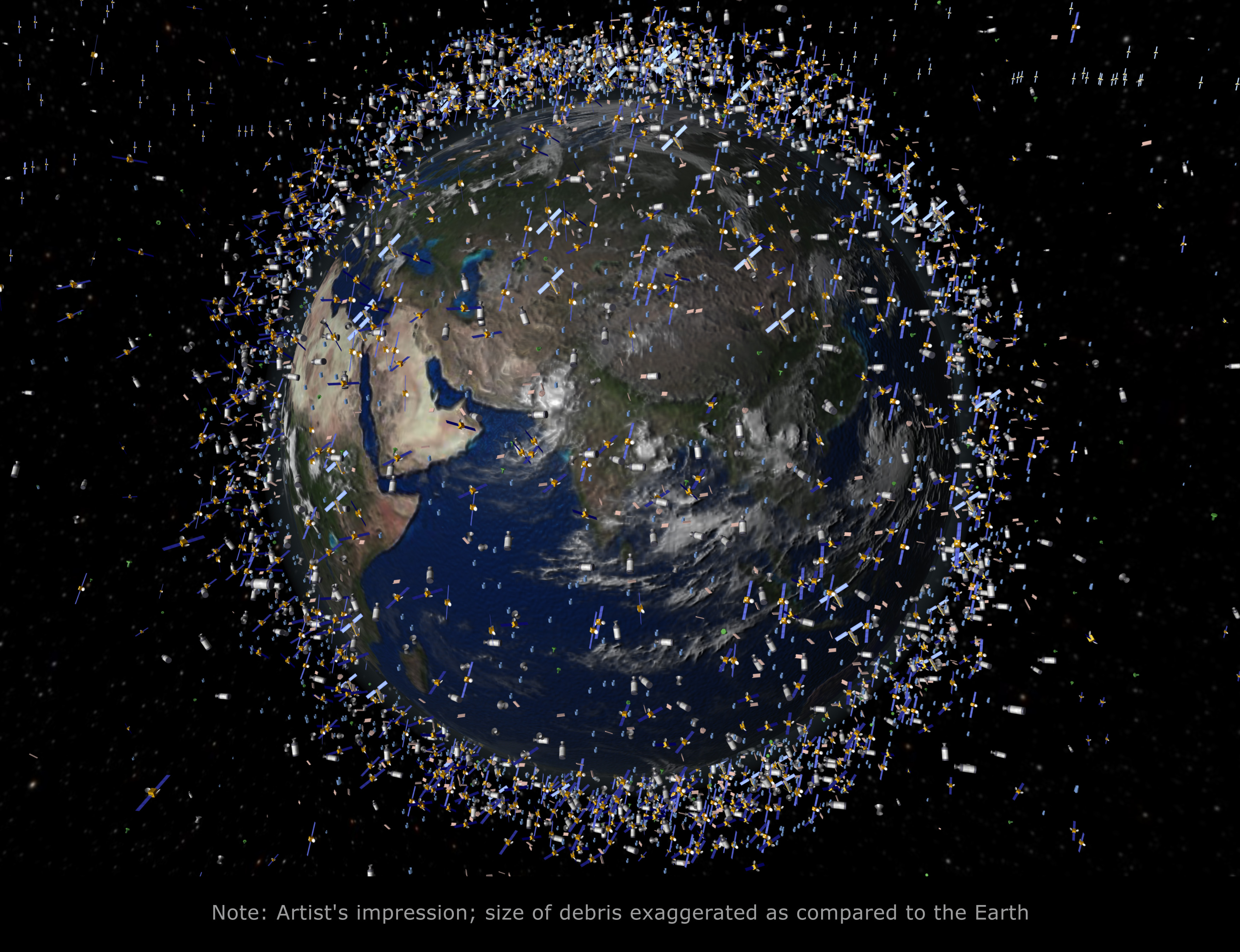
Image courtesy of ESA
Note: The debris field shown in the image is an artist’s impression based on actual data. However, the debris objects are shown at an exaggerated size to make them visible at the scale shown
This week we’re looking at some of the latest the latest policy announcements and reports relating to Earth Observation (EO) around the world:
UK
In November we reported on The House of Lords UK Engagement with Space Committee’ first report, bluntly titled ‘The Space Economy: Act Now or Lose Out’. The overall theme was that the UK could play a bigger role in the global space economy, but lacks a clear implementation approach for achieving this.
Last week the UK Government released their response to the 40 recommendations in the report. The high-level response was that the government was taking a strong ‘one government’ approach to space – whatever that might mean in practice. The rest of the response was typical of a government communication, highlighting things they are about to do and documents they will release later this year, coupled with the amount of money they have already invested or have committed.
EO only got a few mentions in the report, mostly focusing on data, where the Government noted they were working to simplify access to EO data to promote growth and improve public services by promoting to EO Data Hub – although as the support currently ends in March 2026, they will need to be quick; although the response indicates they will explore support beyond this date. The response also highlighted around £85 million of funding across a five-year period from 23/24 to 27/28 for the Satellite Applications Catapult, together with a Defra funded Build and Pitch Hackathon this January for SMEs, government and academia to develop novel products focusing on specific issues in precision agriculture, sustainable spatial planning, and green finance. Finally, the response also acknowledged the critical role the radio spectrum has in EO.
Despite the lack of a lot of detail in the response, it did refer several times to a spring space publication which will outline the ‘one government’ approach to space, updated government priorities and plans for space capabilities, an overall approach to supporting the UK launch sector, approach for research and development for space companies, together plans for delivery and focused multi-year funding.
It appears this spring document could be an interesting read!
United States
In a recent filing to the United States Federal Communications Commission, SpaceX has requested permission to launch a low-Earth orbit constellation of one million satellites that aim to use the power of the sun to generate the energy required by data centres for Artificial Intelligence, as this is expected to be a more efficient approach.
It is highly unlikely that SpaceX will ever launch that many satellites – particularly given that, according the United Nations Office of Outer Space Affairs there are currently approximately 18,000 objects orbiting the Earth. This application is more about positioning SpaceX as a commercial lead for this sector against its rivals, crowding out potential competitors, and it’s also probably related to the anticipated public share offering later this year.
United Arab Emirates
Interesting announcements from the United Arab Emirates indicate that the country is expanding its EO focus, with a greater emphasis on analysing and using EO data including leveraging AI. Reports suggest that using high-resolution data for urban planning, natural resource management, environmental monitoring, food security, and disaster response is part of the next enhancement of their space sector and developing the economic value of EO data.
A Space Data Hub is being established as an innovative ecosystem for EO data, software and technologies, to provide support and assistance for both national and global challenges. It is hoped that it will facilitate greater use of EO data for scientists, researchers, government and private commercial organisations.
India
India has reported that it is increasing its national space budget by 2.1% to a total of US$1.64 billion for the year 2026/27. There are three key priorities readiness for human spaceflight, expansion of EO capabilities which is generally expected to be spent on upstream activities, and expansion of EO services for climate and security which is likely to a greater downstream focus.
It is interesting to see a second country announcing a greater focus on the use of EO data, and it is hoped this will also encourage the domestic private sector space ecosystem to develop further.
Summary
Space assets are becoming more acknowledged as critical national assets, meaning that Governments and large commercial enterprises are taking a much greater interest in directing and controlling such assets.
