

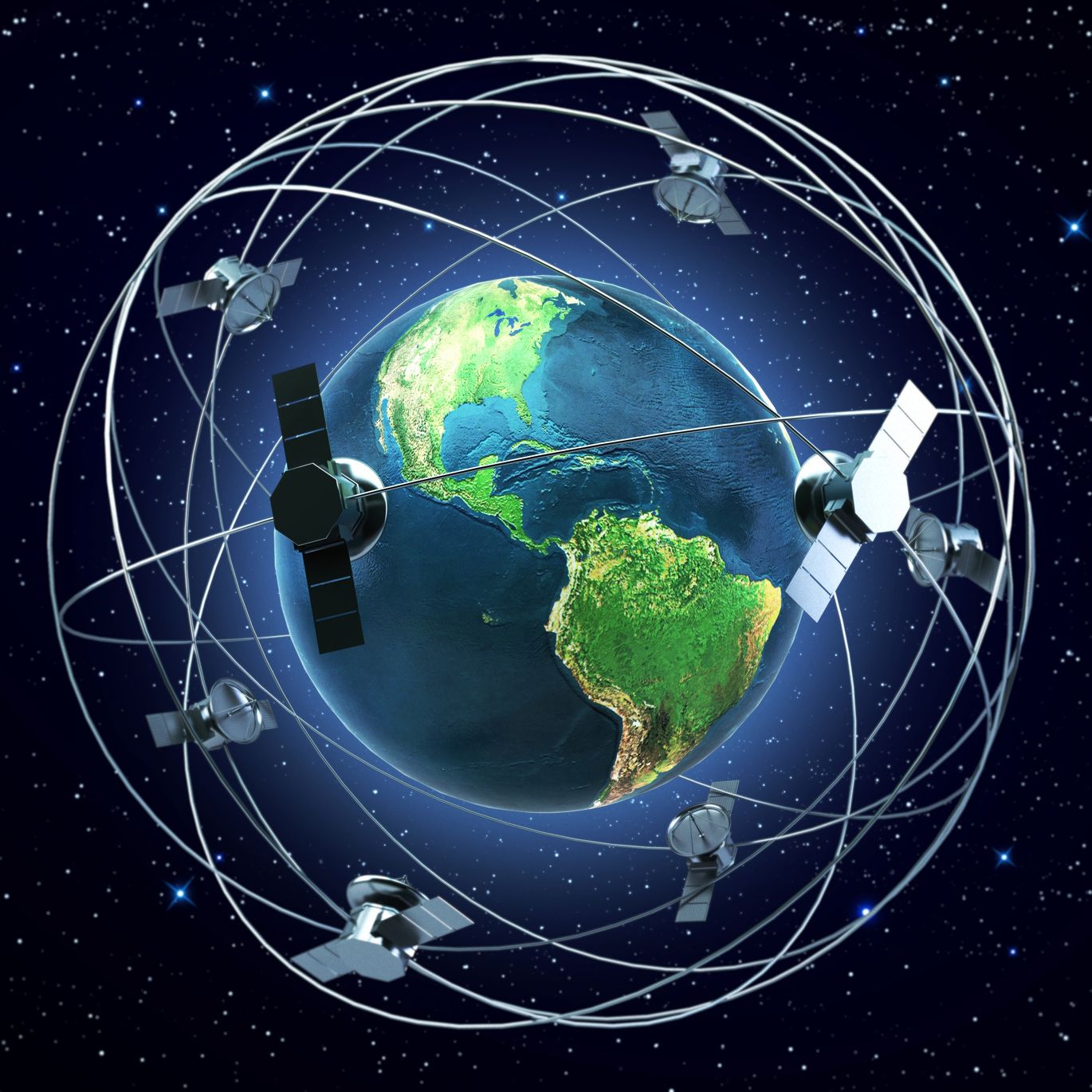
Artist’s rendition of satellites orbiting the Earth – rottenman/123RF Stock Photo
This week we’re looking at the Lazarus qualities of a Chinese satellite, a new international hub for sharing remote sensing data and the South Korean Earth Observation budget and focus for 2022.
China
Last October we wrote about the loss of the Chinese Shiyan-10 satellite whose operating conditions were reported as becoming abnormal after it separated from its launch vehicle. However, to borrow the famous misquote attributed to Mark Twain, the reports of the death of Shiyan-10 appear to be greatly exaggerated.
It was reported this week that Shiyan-10 has been tracked by the US Space Force’s 18th Space Control Squadron, and is now in a Molniya orbit around the Earth. Molniya orbits are a highly elliptical orbit and can be used as an alternative to geostationary orbits for northern hemispheres, particularly when there is a small constellation, as the satellite spends a lot of time over the area of interest and moves quickly over the rest of the planet.
Molniya orbits have been used by Russian satellites in the past as the benefits of this type of orbit were first outlined by Soviet scientists in the 1960s, but this is the first known example for China. Shiyan-10 was believed to be an experimental satellite, but its exact purpose at launch was not released. Therefore, it is not known whether the satellite will continue to operate as originally planned or not – with Molniya orbits historically used for communications, broadcasting, weather monitoring and early warning system applications.
The satellite is believed to be at an altitude of just less than 39,000 km, and would be visible to the China Remote Sensing Satellite North Polar Ground Station, located in Kiruna, northern Sweden for a significant portion of its orbit.
It was also reported this week that the Chinese National Space Administration (CNSA) had established a satellite data centre in Wenchang on the north-east of the island province of Hainan in southern China. This centre is described as being a hub for the international exchange of satellite data, with particular relevance to the BRICS countries of Brazil, Russia, India, China and South Africa. These five signed an agreement in August last year to enhance the sharing of remote sensing data between them.
Russia
This is an interesting development, particularly for Russia, as a lot of space agencies have ended co-operation with the country following the invasion of Ukraine. However, like on so many topics, Vladimir Putin seems unconcerned, and committed to carrying on with Russia’s space exploration program. At a speech on Cosmonautics Day (April 12), he confirmed the that Russia will resume its lunar program with the launch of Luna-25 probe, expand its satellite fleet in space under the Sfera program and announced a a large scale project for developing, building and launching special remote sensing satellites in conjunction with Belarus.
South Korea
Away from China and Russia, South Korea’s government announced last week that they are increasing space industry spending by 19% compared to 2021 levels. They are investing $619 million in 2022, more than 15% than originally proposed.
South Korea is seeking to further develop its launch facilities following the failure of its Nuri rocket to put a satellite into orbit in October 2021. It is expected that large amounts of the funding will be devoted to Earth Observation (EO) with:
- Launch of CAS500-2, an optical EO satellite with multispectral modes with 2 m spatial resolution, and a panchromatic mode with 0.5 m resolution.
- Launch of KOMPSAT 6, a radar satellite with 0.5 m spatial resolution.
- Development of KOMPSAT-7, the design of six remote sensing or communication satellites and opening a new satellite operations centre.
However, the two launches were due to take place via on separate Russian Soyuz rockets this year, and therefore there is uncertainty as to whether they will take place as planned.
All of this again shows that the space industry continues to develop and evolve across the globe.
