

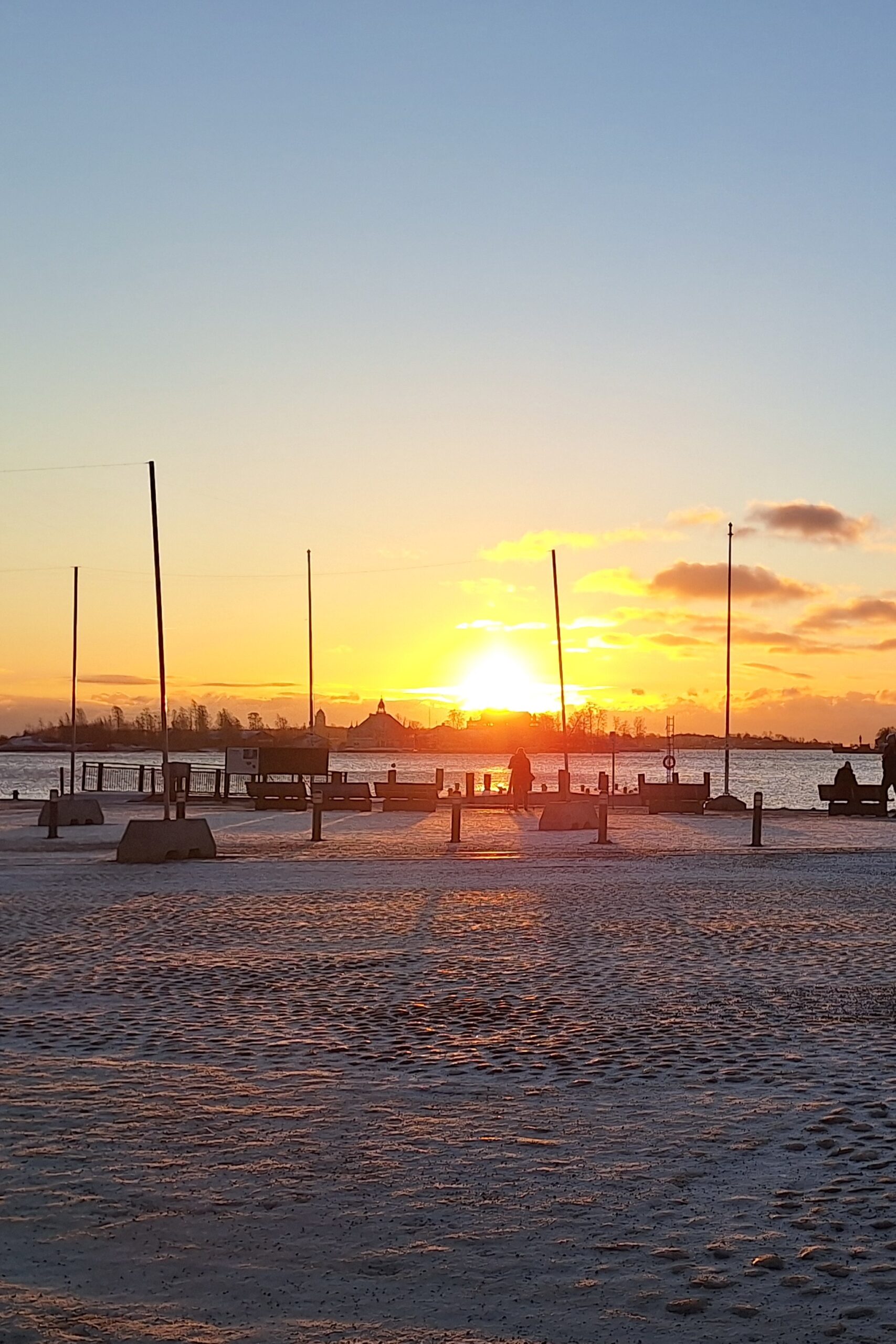
Port of Helsinki, Finland. December 2024.
The final stage of my Scandinavian journey took me to Finland, specifically Helsinki, where I attended the 14th Workshop on Hyperspectral Image and Signal Processing: Evolution in Remote Sensing (WHISPERS) that took place on the 9th to 11th December 2024 at the Paasitorni Congress Center.
I attended the conference to present the work from the Hyperspectral Chroma-D Instrument (HERCHI) Payload Development project led by Surrey Satellite Technology Ltd, where we’ve been looking at what’s need to support the satellite-based measurement of atmospheric pollution and greenhouse gases and how these fit within the existing supply chain. My presentation was on the afternoon of day one, and the conference began with two keynote presentations.
The first keynote was given by Petri Pellikka on ‘Hyperspectral remote sensing of land cover characteristics and dynamics in versatile landscapes of East Africa’. He showcased the many years of research linked to the Taita Research Station located in Wundanyi, Taita Taveta County in southeastern Kenya. Over time, the area has seen the amount of land used for crops increase, but also agroforestry has developed as there is a requirement for farmers to keep trees on 10% of their farm. In the highlands, fog deposits on the trees resulting in the capture of 20% more water compared to unforested areas. He also highlighted that elephants in the conservation areas are reducing tree cover due to their need to find food and 35% of trees are not native with invasive species causing issues as well as offering important crops. Remote sensing work in the areas has historically relied on aircraft overflights, while the longer-term aim is to have a greater usage of drone and hyperspectral satellites so more frequent imagery can be collected.
The second keynote by Juan Antonio Fernandez Pierna focused on ‘Hyperspectral Imaging: perspectives, challenges and opportunities. Applications in the agro-food sector’ and how lab-based capabilities had been developed in terms of both techniques and applications. His approach was to use multiple techniques throughout the terahertz, near infrared (NIR), visible and ultraviolet electromagnetic spectrum. The data from all these sources is then combined using Machine Learning (ML) and parallels were drawn with chemometrics – extracting information from chemical systems by data-driven means.
My presentation was after lunch in a session titled ‘Hyperspectral Imaging Solutions for Small Space Platforms’. It began with a presentation on new hyperspectral imaging instruments for detecting methane from drones with the aim of reaching a ground sampling distance of around 5 metres for the visible/NIR system, and 3 metres for the shortwave infrared (SWIR) system when the drones were flying as high-altitude platforms (HAPS) at an altitude of approximately 20 km. By flying such systems over oil & gas infrastructure they can detect leaks, saving money and reducing harmful emissions.
The second talk focused on a specific aspect of hyperspectral cameras – the point spread function (PSF) that defines how spread a point signal is across both the detecting pixels and those surrounding it. This spread of light beyond the target pixel can occur both spatial – varying with the pixel – and throughout the bands. This wavelength dependent shift is currently accounted for, but not fully, in terms of the size and shape of the PSF and so a practical method for measuring and accounting for it was presented. The third presentation took a step back from the technical details and focused on the diversity of hyperspectral missions being launched and the need for careful in-orbit calibration to ensure the products meet the expectations of end users. The session ended with my presentation on the work of the consortium on the Hyperspectral Chroma-D Instrument (HERCHI) Payload Development project.
The remaining days were full of fabulous presentations, including an interesting presentation on detecting hazards in food such as listeria – here again, ML was used with object detection techniques first finding probable pathogens and then a suite of different techniques being combined to identify them.
There was also a plenary presentation on a new hyperspectral standard from IEEE (IEEE4001) that focuses on hyperspectral imaging and the performance of the instrument. It’s out for public comment, but unfortunately, it’s not freely available as you need to be a member. However, they were looking at what sponsorship would be needed to make it open access.
The end of the conference saw the conclusion of my Scandinavian adventure, and I was able to head home. I’m glad to back and look forward to the holidays, but I will back on my travels early in 2025!
