

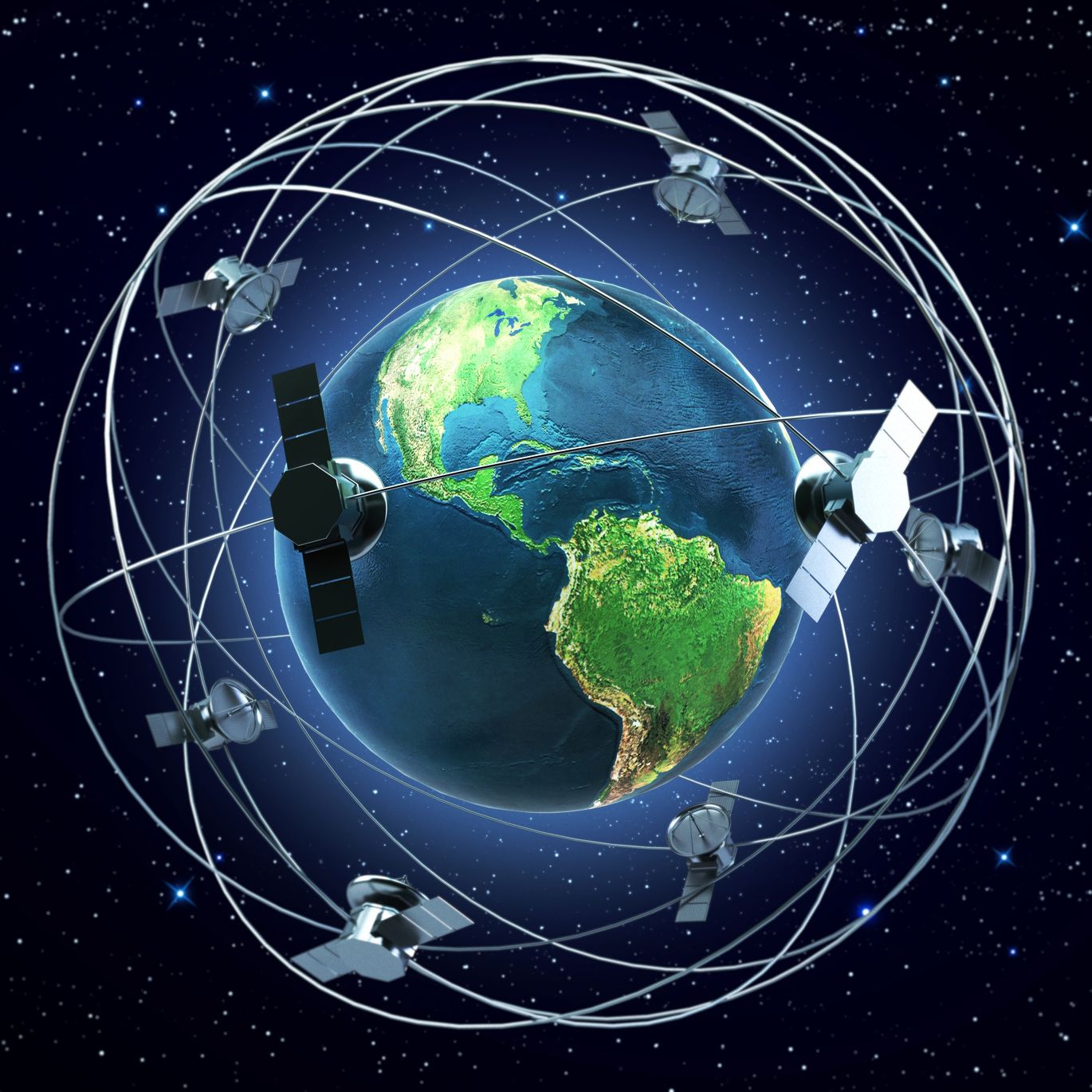
Artist’s rendition of satellites orbiting the Earth – rottenman/123RF Stock Photo
As discussed last weeks, satellite numbers in space changes frequently. This week has been another great example of this:
Successful Satellite Launches – China
The China Aerospace Science and Technology Corporation confirmed the successful launch of 12 satellites last Wednesday, from the Jiuquan Satellite Launch Center. The satellites were for a group of organisations led by Chinese company’s Guoxing Aerospace Technology Co., Ltd and Zhejiang Lab.
The satellites are reported to form the ‘Three-Body Computing Constellation’ to process data in space, rather than having to download the data back to Earth – it is claimed to be the first dedicated orbital computing constellation. The constellation has a capability of a combined 5 peta operations per second with 30 terabytes of onboard storage. The satellites have remote sensing payloads on-board, together with artificial intelligence (AI) capabilities and laser inter-satellite links of up to 100 Gbps.
These satellites are part of a wider ambition to build a network of 2,800 satellites in space as part of the Star-Compute Program and support China’s ambition to be the global AI leader by 2030.
This was followed on Saturday by the launch of six satellites for the Chinese commercial satellite builder Spacety, also from the Jiuquan Satellite Launch Center, but these were put into orbit by the Zhuque-2 methane-fuelled rocket from the Chinese commercial launch company Landspace.
The six Tianyi satellites were:
- Tianyi-42 carrying a commercial C-band synthetic aperture radar instrument,
- Tianyi-29 and 35 carrying optical remote sensing instruments, and
- Tianyi-34, 45 and 46 carrying space science experiments.
Successful Satellite Launches – Japan
Also on Saturday, Rocket Labs successfully launched the QPS-SAR-10 satellite from New Zealand using its Electron rocket for the Japanese Institute for Q-shu Pioneers of Space, Inc (iQPS).
As the name suggests the satellite carries a synthetic aperture radar (SAR) instrument, in this case it is an X-band SAR. It has sub-metre spatial resolution and was put into orbit at an altitude of 575 kilometres and joins five other satellites in orbit with IQPS having the intention to create a 36 strong constellation.
QPS-SAR-10 is known as Wadatsumi-I, after a water deity in Japanese mythology. Rocket Labs joined in with the theme by calling the mission ‘The Sea God Sees’ – the company is known for their quirky and fun mission names.
Unsuccessful Satellite Launch
Sadly, not everything launched has a successful conclusion. The Indian Space Research Organisation’s (ISRO) confirmed that their intended launch of the EO satellite Earth Observation Satellite-09 (EOS-09) was unsuccessful last weekend.
The satellite was being taken into orbit by India’s Polar Satellite Launch Vehicle (PLSV) from the Satish Dhawan Space Centre. Unfortunately, due to a drop in the chamber pressure of the motor case in the 3rd stage the mission was unsuccessful, and the satellite failed to go into orbit. This is only the third failure of PLSV in over thirty years, so it’s generally a reliable launch vehicle.
It was suggested that the rocket would have fallen into the sea, as the pressure anomaly occurred at around 450 km. ISRO are continuing to investigate the issue to determine the reason for the anomaly.
E0S-09 was carrying a C-Band Synthetic Aperture Radar (SAR) instrument with a one metre spatial resolution and was a repeat of the EOS-04 mission that was launched on the 14th February 2022. The pair of satellites would have increased the frequency of imagery acquired and was expected to be used for applications such as reconnaissance, weather forecasting, flooding, wildfires, and disaster monitoring.
Conclusion
As we discussed in the previous blog, the space sector is a rapidly changing one. From last Thursday to now, there has been 44 new satellites launched – the ones listed here, plus 25 Starlink satellites last Thursday – we’ve also obviously had the loss of EOS-09. This just demonstrated how difficult it is know exactly how many satellites are orbiting the Earth today!
