

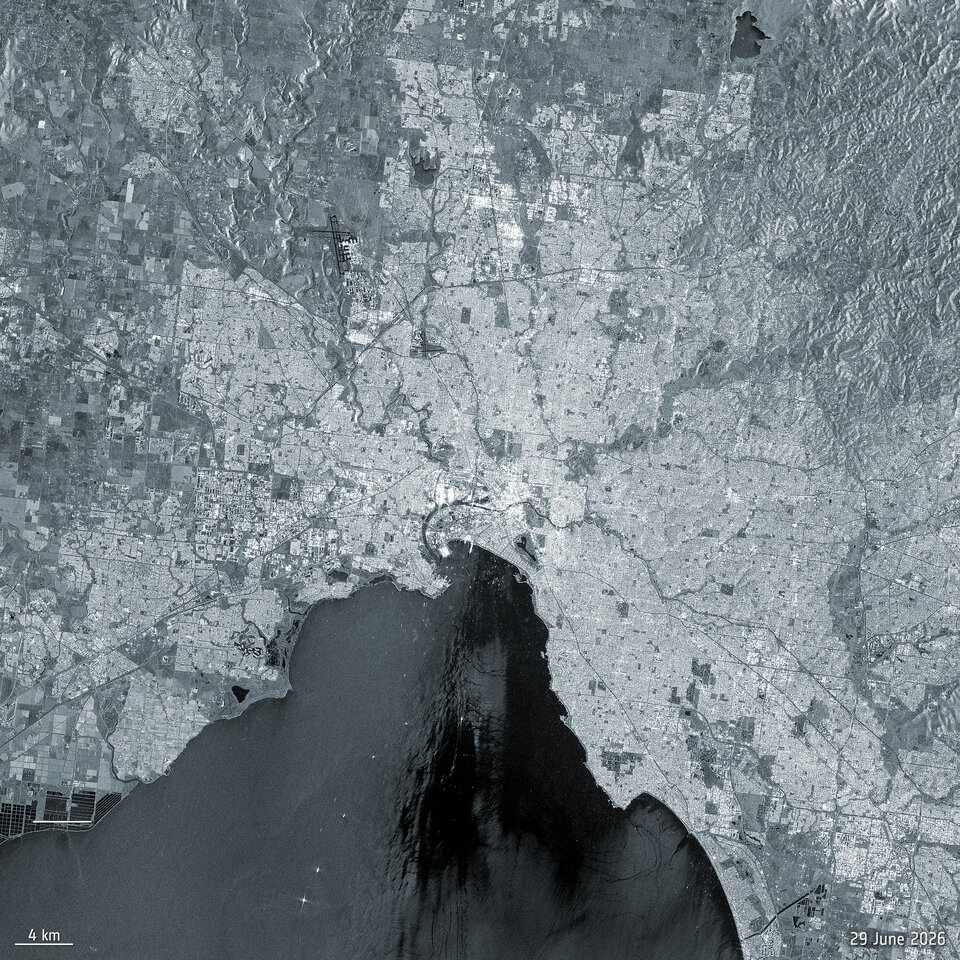
Image of Melbourne in Australia aquired by Sentinel-1A on 29th June 2026 at 19:42 UTC.
Image Credit: contains modified Copernicus Sentinel data (2026), processed by ESA.
Highlighting two contrasting approaches to satellite sovereignty within the Earth Observation (EO) sector this week, starting with news on the demise of Sentinel-1A and then moving onto interesting reports from Russia.
Sentinel-1A
Following last week’s blog about the contract for Sentinel-1 Next Generation, this week the European Space Agency has announced that Sentinel-1A has reached end of life, with the mission ending on the 29th June 2026. Sentinel-1A was launched on the 3rd April 2014, as the first satellite in the Copernicus Programme, which has since become the bedrock of both the European Union’s satellite programme and a huge free-to-access dataset for companies, scientists and researchers. One of Sentinel-1A’s last images, acquired on the final operational day was of Melbourne, Australia, and can be seen at the top of the blog.
The satellite was originally scheduled for a seven-year mission, but it has significantly exceeded that ambition. That is not to say its journey has not been without incident; on the 23rd August 2016 it was struck by a millimetre-size object causing damage to its solar array, and its twin, Sentinel-1B, suffered a technical issue in December 2022 meaning it was turned off, leaving 1A alone for two years until 1C was launched.
Data continuity is secured this time as ESA has recently been manoeuvring all three Sentinel-1 satellites into new orbits to ensure 1C and 1D were in the right positions to take over, 180 degrees apart, to ensure seamless transition and maintain global data continuity. As discussed last week, the follow-on missions are already in planning and development.
At Pixalytics we have used Sentinel-1 images for many years in a variety of applications, and we are sad to see 1A disappear after some many years of work, but it is great to know that the dataset continues.
Satellite Sovereignty
Space has been quite a collaborative sector for the last few decades, but recently there has been a greater emphasis by some countries on having their own satellites and not having to rely on other countries to get their satellite imagery. This is due to several examples of satellite services being unilaterally shut down or restricted by external operators under certain circumstances, which reduces or limits a government’s ability to understanding what is happening, make decisions and act.
Interesting reports from Russian describes how they are taking the sovereignty to the next step. Firstly, the Russian State Space Corporation, Roscosmos, recently indicated their intention to build Russian satellites without using any foreign components – in principle, this is not that usual as many countries strive towards building indigenous satellites to help develop their own space sector, but it’s not clear how many are aiming to build without foreign components. However, a far more interesting development is that from 28th June, Roscosmos will start checking the number of Russian components in commercial satellites as part of any decision to purchase imagery. An assessment of the dependence of foreign components and the security of the data will need to be passed for purchase – although, there is an exception if the required imagery cannot be obtained from approved satellites.
Conclusion
An interesting juxtaposition in the blog this week, starting with the ongoing success of the Copernicus programme developed, built and run through collaborative processes within the European Union and ESA, and then ending with the new completely opposite approach from Russia with an isolationist preference. If the Russian approaches proliferates, it could fundamentally change the way the EO sector operates and is something to monitor for the future.
