

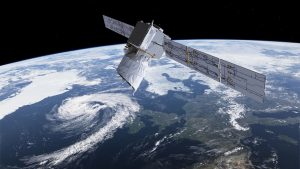
Artists Impression of ESA’s Aeolus wind mission. Image courtesy of ESA/ATG medialab.
Last week we focused on the insurance side of what happens when something goes wrong in space. This is an unexpected follow-up, or part two, of that blog as by coincidence a couple of high-profile examples have occurred in the last week of events that could potentially lead to such insurance claims.
Firstly, it was confirmed that on Monday 2nd September that ESA had undertaken a ‘collision avoidance manoeuvre’ for its Aeolus Earth observation wind satellite, to prevent a potential collision with the Starlink 44, a small satellite weighing approximately 227 kg in the SpaceX low earth orbit constellation aiming to provide broadband Internet access.
This involved undertaking three thruster burns on Aeolus to change its orbit by 350 m. At the point of action, the potential for collision was estimated to be around 1 in 1 000, ten times higher than ESA’s acceptable risk level. Although these manoeuvres do occur, it is rare to involve another active satellite as they are normally linked to space debris.
The 18th Space Control Squadron of the US Air Force monitor objects orbiting the planet, and towards the end of August, their data identified a potential collision. ESA and SpaceX discussed the issue, although there is a difference of opinion on how things evolved. According to ESA, SpaceX decided not to take any action to change the orbit of Starlink44 and as the collision risk increased over the following days ESA decided to act to protect Aeolus.
Whereas, after having their actions questioned, the following day SpaceX released a statement noting that at the initial contact both parties agreed there was no need to take any action. However, as the risk increased, unfortunately, a bug in their on-call paging system prevented Starlink from seeing the follow-on messages on the probability increase. If they had seen them, they would have discussed with ESA the best approach to avoid the collision that could have involved either satellite or both, manoeuvring.
Irrespective of the ultimate cause of this issue the fact the communication and coordination between satellite operators is via email and on-call paging systems is a concern as the number of satellites increase.
Given the sheer number, and value, of proposed future satellites, it seems that the potential for collisions is increasing and better solutions for tracking and monitoring are required. ESA themselves, who attributed no blame for this incident, are proposing a more automated solution to monitor satellite collisions which can help provide an early warning system for satellite operators.
The second example this week, is the unfortunate news that the Indian Space and Research Organisation (ISRO) lost contact with its Moon lander on the 7th September, just seconds before it was due to touch down on the Moon.
The lander, named Vikram, has been located by Chandrayaan-2 spacecraft orbiting the Moon. It appears to be unbroken but ‘tilted’ on its side and ISRO is currently unable to contact it. The unit was due to be powered by a combination of solar energy and a battery pack, and it is unclear if either of these are currently working. The planned mission on the lunar surface would have lasted two weeks and focussed on detecting water and minerals.
These are two current real examples of things that can go wrong in space, and why there is interest in space insurance.

It’s a definitely wonderful article. Thanks for sharing this good one article. It’s really helpful for everyone. It’s so informatic.