

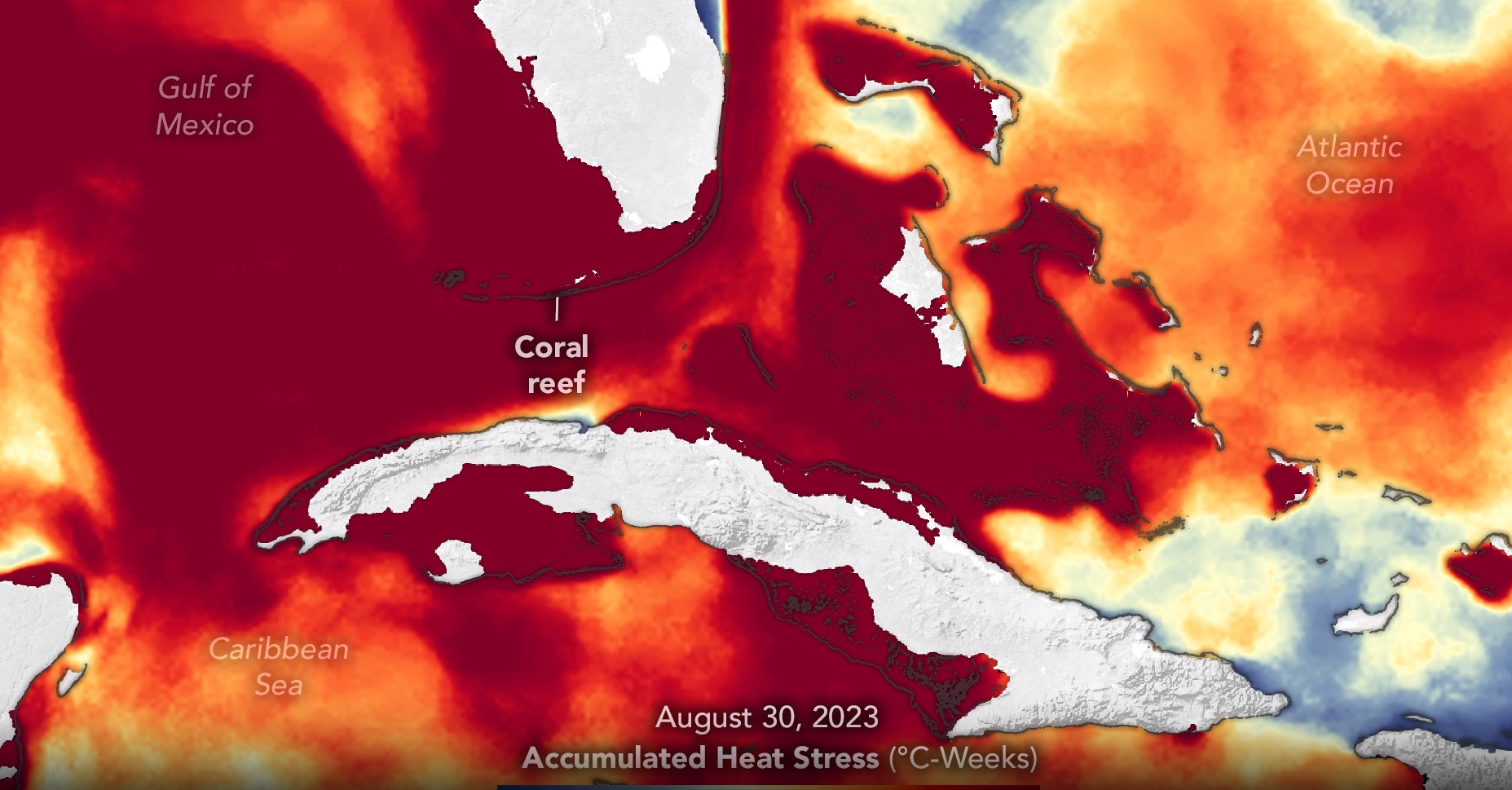
Still image from a NASA Earth Observatory animation by Wanmei Liang, using Daily 5km Degree Heating Weeks data from Coral Reef Watch. Coral reef data from UNEP-WCMC, WorldFish Centre, WRI, TNC. Image courtesy of NASA Earth Observatory
There have been a couple of interesting documents issued recently regarding the state of our oceans.
European Union Copernicus Ocean State Report
Last week saw the publication of the 7th edition of the European Union Copernicus Ocean State Report (OSR 7). The report details the state of the ocean up to 2021 and is coordinated by Mercator Ocean International for the Copernicus Marine Service; issued annually. It is used as a reference by scientists, blue economy community, decision-makers and the wider public.
The 7th edition highlights several unusual patterns across ocean systems, together with new tools and technologies to help scientists better monitor, understand, and forecast a changing ocean. A couple of the highlights that caught our attention were:
Marine Heatwaves
A marine heatwave is defined as a period of abnormally high water temperatures lasting at least five consecutive days. The report notes an upward trend of these events, both in the European regional seas and the global oceans, except for the Southern Ocean. The report highlights that there has been an additional heatwave every five to ten years, and extreme marine heatwaves are occurring at a slightly increased rate. In addition, there has been a downward trend in the frequency and intensity of marine cold spells.
Although this report has focused on the state of the ocean until 2021, it reports some later observations supporting these trends:
- In April 2023, the global sea surface temperature reached 21.1C, surpassing the previous record of 21C in 2016.
- In May & June 2023, the Antarctic sea ice extent fell to the lowest recorded levels since satellite records began. This resulted, in June 2023, in the loss of nearly 2.2 million square kilometres of sea ice.
- Summer 2022 broke records for the intensity and duration of marine heatwaves in the Mediterranean Sea.
These temperature changes can have a significant impact on marine life ecosystems and biodiversity, and are dangerous to coral reefs; as discussed below. In addition, they can have a significant effect on seagrass, kelp and fish species, which impacts the broader marine ecosystem.
Phytoplankton Blooms
Two significant coccolithophore blooms were observed around Scotland during the summer of 2021, indicating unusual phytoplankton activity. The first occurred in the Clyde Sea, where a wet and stormy month of May added nutrients to the sea and then, with increased sunlight and summer temperatures, led to a vast bloom that turned the sea turquoise. The second bloom occurred around the Shetland Islands a little later in the summer, again creating a very visible bloom.
Changing weather patterns, sea temperatures and nutrients available within the sea can influence the occurrence of coccolithophore blooms, which have been seen further towards the poles in recent years.
Further Observations
OSR 7 has a lot more information than a single blog post can contain, and is fascinating for anyone with an interest in the health of our oceans, as it also contains details on coastal upwelling and ocean heat exchange together with new tools for monitoring coastal upwelling and dissolved oxygen in the water.
NASA Earth Observatory
Following the OSR 7 highlighting rising sea temperatures, NASA Earth Observatory also issued an article recently that highlighted the impact of record global sea temperatures this summer on the health of coral reefs.
Coral bleaching occurs when water stresses cause coral to expel the photosynthetic algae, which give coral their colours, exposing the skeleton and turning them white. The stress is primarily because of higher seawater temperatures; although cold water stresses, run-off, pollution and high solar irradiance can also cause bleaching. Whilst bleaching does not kill coral immediately, it puts them at a greater risk of mortality from storms, poor water quality, disease and the crown-of-thorns starfish.
Divers found the marine heatwave in the summer of 2023 caused widespread coral bleaching around the Florida Keys. The corals suffered heat stress from July to September, with figures in August consistent with a widespread bleaching and mortality event. The heat stress stretched across Cuba and the Bahamas as well. The risk of bleaching has not dropped significantly, as the waters around these areas are still on bleaching alert in October.
Bleaching events are important as while coral reefs represent less 0.1% of the ocean’s surface, they are one of the most diverse ecosystems and losing corals is a loss to the entire world.
Summary
Changes in the oceans matter! Whether this is sea level rises from melting ice that will contribute to coastal flooding, or impacts on the fishing industry, and eating habits, from changing catches in local waters, or losing coral ecosystems. While you may think they are happening out in the ocean, be aware that they will impact everyone.
